 By Amotion AI
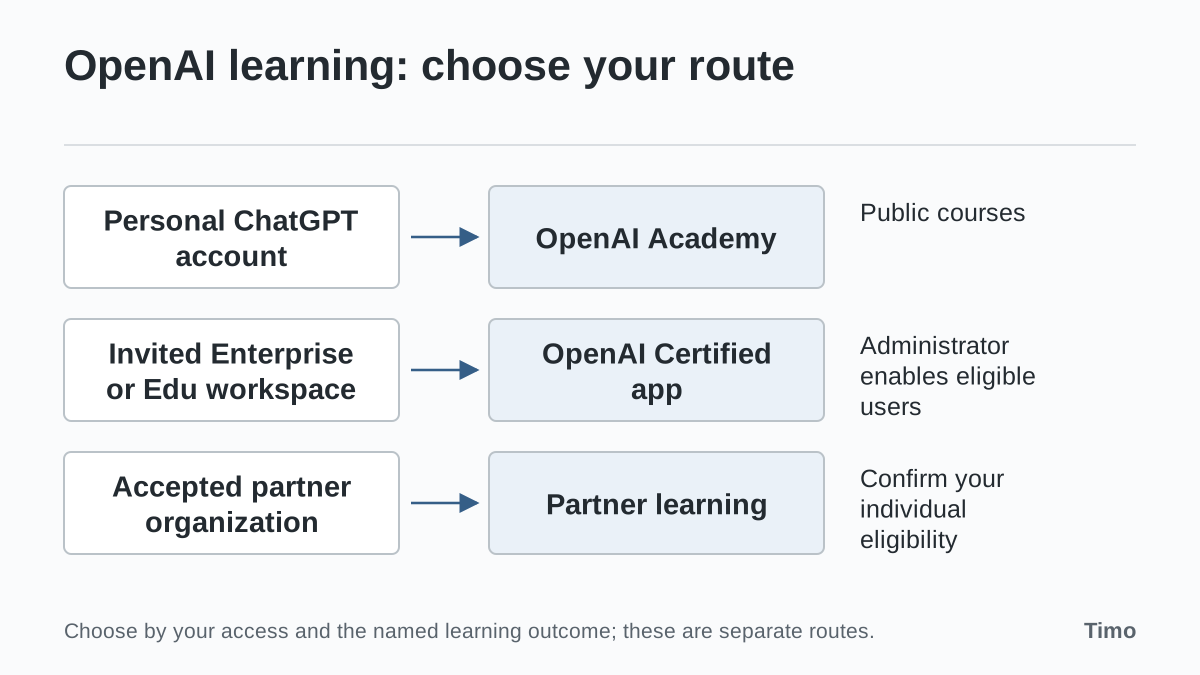
For an individual, “OpenAI certification” can refer to several different routes. These include an OpenAI Academy learning record, an OpenAI Certified credential through an invited workspace, or partner learning made available through an organisation. Check the exact outcome and access owner before choosing a route.
Compare the three routes
| Route | Who can start | Possible record | What to verify |
|---|---|---|---|
| OpenAI Academy | Anyone globally with a ChatGPT account | Course badge; certificate of completion for an eligible pathway | Course, assessment and account email |
| OpenAI Certified | Eligible users in invited Enterprise or Edu workspaces | OpenAI-issued credential where available, delivered through Coursera and Credly | Invitation, admin enablement, role access and eligible course |
| PartnerU | A learner provisioned through a participating organisation | The exact program completion or award shown in the learner account | Named program entitlement, identity, requirements and award |
Each is a separate access route with its own outcome. Academy’s current guide says its badges and pathway certificates of completion are not certifications. OpenAI Certified has its own eligibility rules. A PartnerU administrator seeing a program in a catalogue does not prove that every learner can open it or earn an award.
The learning emphasis also differs. Academy offers subject-based study across workplace use, AI adoption, API application development, evaluations, retrieval, agents and Codex. OpenAI Certified provides supported learning and assessments inside eligible workspaces. The PartnerU catalogue reviewed through Amotion grouped some programs around customer solution fit and handoff, others around deployment, and one around technical considerations such as models, architecture, security and governance.
A badge, a completion certificate and a certification mean different things
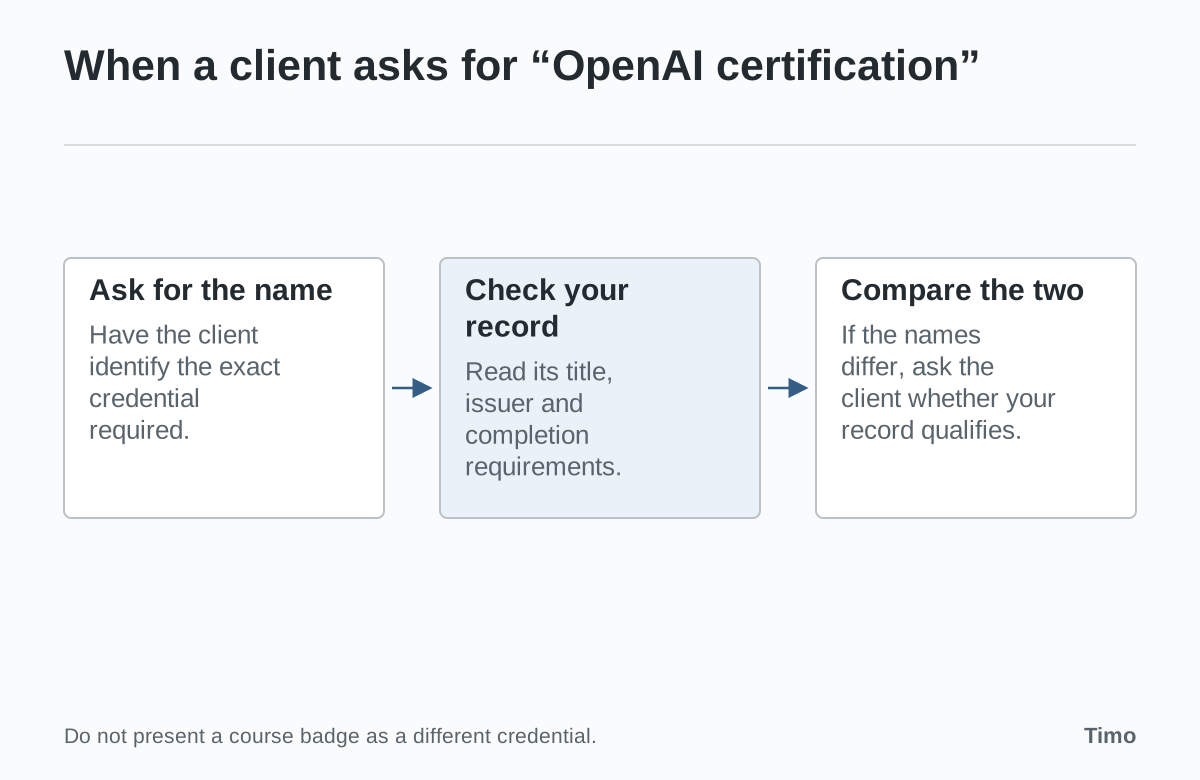
A course badge records completion of one named course and its assessment. A pathway certificate of completion records the required courses and assessments in an eligible Academy pathway. A certification credential belongs to a separate provider-defined assessment and eligibility process. Use the exact title and issuer shown on the record you earned.
Use Academy when you need an individual starting point
OpenAI says Academy courses are free and available globally to anyone with a ChatGPT account. The current catalogue includes workplace, technical, leadership and education subjects. Every course includes an assessment; a badge requires completion and a score of at least 80%. Eligible pathways require all listed courses and assessments.
Choose by the work you want to improve. A finance analyst who wants better management updates might study prompting and repeatable workflows, then build a fictional variance-commentary sample. The learning record shows what was completed; the sample shows how the analyst checks numbers, preserves missing causes and routes decisions to a human.
Before starting, confirm that you are signed into the account you want attached to your progress and badges. OpenAI says Academy accounts cannot currently be merged after a course begins.
OpenAI says Accredible issues and manages Academy badges and pathway certificates. That differs from the OpenAI Certified route, where eligible OpenAI-issued credentials are delivered through Coursera and distributed through Credly. Record the issuer and platform shown on your own credential rather than assuming they are interchangeable.
Use OpenAI Certified only after the workspace conditions are confirmed
OpenAI describes OpenAI Certified as a Coursera-powered learning experience in ChatGPT. As checked on 20 September 2026, it is invite-only for ChatGPT Enterprise and Edu workspaces. An administrator must enable it, an eligible member must connect it, and the learner needs a Coursera account. Eligible credentials may be delivered through Credly.
A workspace is the organisation-managed ChatGPT environment through which an employer or education institution controls access, roles and apps. Being a member of an Enterprise or Edu workspace does not itself prove that the workspace was invited to OpenAI Certified.
Having Enterprise or Edu is only one condition. Ask the administrator:
- Has this workspace been invited?
- Has OpenAI Certified been enabled?
- Does my role have access?
- Which named course or assessment is eligible for a credential?
Buying an individual subscription does not satisfy these workspace conditions. If the app is absent, do not treat that as a learner failure until the administrator checks the invitation and permissions.
Treat partner learning as an organisation-managed route
What the partner route adds
PartnerU is tied to an organisation’s OpenAI Partner Network relationship. Separate three facts:
- the organisation participates in the partner program;
- a learner identity has been provisioned;
- the learner has access to a named program.
Only the third fact establishes that a particular learner can take that program. Program completion, a program exam and a wider skill designation may also be different outcomes.
What is partner-specific, and what is also public?
PartnerU adds an organisation-managed path and customer-delivery context for an entitled learner. Public Academy and developer resources also cover many underlying subjects. The specific program, exercises and requirements in the learner account define the partner learning actually received.
Does PartnerU completion make you a ChatGPT Expert?
In the 17 September administrator snapshot, the ChatGPT Expert path listed four core programs: ChatGPT Solutions Practitioner, OpenAI Technical Practitioner, ChatGPT Deployment Practitioner and OpenAI Consultative Solutions Practitioner. It also listed a separate ChatGPT Expert Capstone & Final Exam. A final exam inside one practitioner program is therefore different from the Expert capstone, and the four core listings alone did not establish the wider Expert award. Use the current Expert requirements and the exact award shown in your account.
Timo enrolls consultants who want to develop OpenAI skills and work on enterprise AI projects. Enrollment starts with your professional profile. Enrolled Timo consultants sign a consulting agreement with Amotion AI and use their Amotion AI consultant email for the approved OpenAI learning programs and badge paths. That managed identity is not a general company mailbox. The written onboarding information must name the resources approved for the learner. See the individual registration guide for the current process.
Work through three common decisions
You have only a personal account
Start with Academy and use the official course page to confirm the current course and outcome. Do not wait for an employer invitation to begin learning. Do not describe an Academy badge as certification.
Your employer uses ChatGPT Enterprise
Ask the four workspace questions above. If the workspace has not been invited or your role is excluded, Academy remains available while the organisation decides what to enable.
You want partner-oriented consulting learning
Ask the supporting organisation to name the program, learner identity, start condition, completion requirement, possible award and support owner in writing. After onboarding, test that the named program opens in the learner account. A catalogue screenshot from an administrator is not a substitute for that test.
Check the claim you can safely make
Use a four-column record:
| What I completed | Issuer shown | Evidence link | Wording I will use |
|---|---|---|---|
| Exact course or assessment | Exact organisation on record | Shareable credential or completion page | Exact title, without upgrading it |
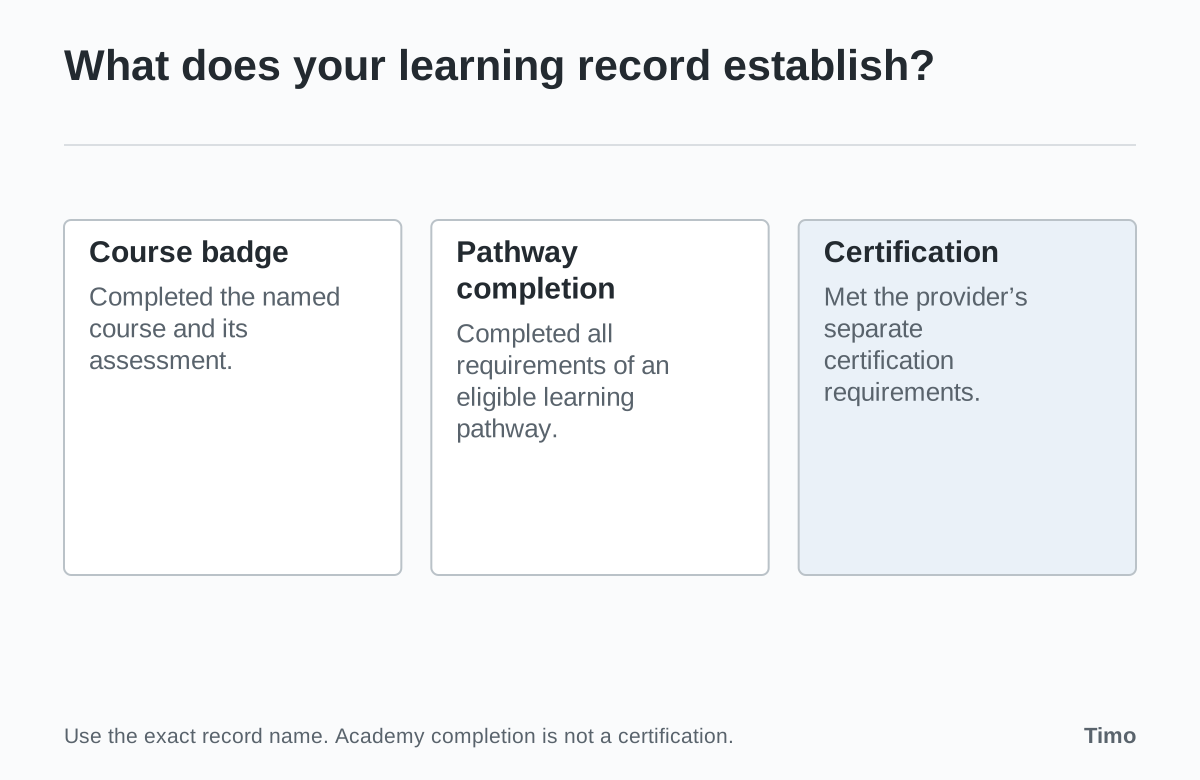
If a client asks for “OpenAI certification,” ask for the required credential name, issuer and verification method. Then compare that requirement with your record. A relevant course and a strong work sample may still be useful, but they are not substitutes when the buyer requires a named certification.
After choosing a route, build evidence of application. The ChatGPT learning path without coding develops a checked weekly update. The badge-to-work-portfolio guide shows how to present inputs, failures and corrections. For the organisation-managed route, use the PartnerU access guide.
Frequently asked questions
Can an individual pursue OpenAI learning without an employer?
Yes. Academy is the public individual route. OpenAI Certified currently depends on an invited Enterprise or Edu workspace. Partner learning depends on an organisation provisioning the learner for named resources.
Is OpenAI Academy free, or do I need ChatGPT Plus?
OpenAI’s current guide says Academy courses are free and require a ChatGPT account. It does not require a workspace membership.
Can I call an Academy pathway certificate an OpenAI certification?
No. OpenAI calls it a certificate of completion and explicitly distinguishes it from certification.
My employer has Enterprise. Why can I not find OpenAI Certified?
Enterprise membership alone is insufficient. The workspace must be invited, an administrator must enable the app, and your role must have access.
Can a freelancer join partner learning independently?
A freelancer can apply through an organisation-supported route such as Timo. The supporting organisation must provision the learner and confirm the named resource. This does not make the freelancer an OpenAI partner.
What should I do if a client asks for “OpenAI certification”?
Ask for the exact credential, issuer and verification method. Compare that requirement with the exact record you hold.
How can Timo help me choose an OpenAI learning and certification route?
Submit your profile to Timo and state the route and work you want to pursue. As a Timo consultant, review the agreement, consultant account requirement, named OpenAI resources and completion outcomes before continuing. OpenAI controls its own programs and awards.
Public OpenAI facts were checked against the official Academy and OpenAI Certified help pages on 20 September 2026. The dated PartnerU evidence and its limits are explained in the PartnerU access guide.
Sources and review scope
Public eligibility and credential statements come from the linked OpenAI help pages checked on 20 September 2026. PartnerU details come from a bounded authenticated administrator review on 17 September; they are not a live learner-entitlement test.