 By Amotion AI
CCAR-F · Free practice exam · No sign-up
Claude Certified Architect practice exam (CCAR-F Foundations)
Take a free 20-question practice exam for Claude Certified Architect Foundations (CCAR-F) in 40 minutes. You get your score, results by topic and an explanation for every answer option.
Loading your practice exam…
Employer not a Claude partner?
If your employer is not a Claude partner but you want to become Claude certified, enroll with Timo.
Enroll with TimoCovers: Agent architecture, tool design, MCP, context management and reliability.
From practice to certified
Practise free
Take the free 20-question CCAR-F practice exam. No sign-up.
Enroll with Timo (paid)
Enrolled users get 1,180 practice questions in 20 full-length mock exams, plus OpenAI partner courses and badges.
Book your exam
As a Timo consultant, you register for all four Claude certification exams under Amotion AI, which is Certified in the Claude Partner Network. You pay the exam fee to Anthropic.
Independent Timo preparation material. This is not an official exam and is not supplied or endorsed by Anthropic. A practice score is not a prediction of passing.
What the 20 questions cover
| Official domain | Official weight | Free questions |
|---|---|---|
| Agentic Architecture & Orchestration | 27% | 4 |
| Tool Design & MCP Integration | 18% | 4 |
| Claude Code Configuration & Workflows | 20% | 4 |
| Prompt Engineering & Structured Output | 20% | 4 |
| Context Management & Reliability | 15% | 4 |
| Total | 100% | 20 |
Study each topic: CCAR-F study guide.
This free set does not follow the official domain weights. The table shows the actual number of questions in each domain.
Claude Certified Architect Foundations exam guide
The official exam has 60 scenario-based questions in 120 minutes and a pass mark of 720 on a 100 to 1,000 scale.
All 20 CCAR-F practice questions with answers
These are the same 20 questions as the practice exam above. Take the timed practice exam first, then use this list to check each answer and its source.
Show all 20 questions
-
Question 1
Agentic Architecture & Orchestration
Northline Ferries has a customer assistant that calls the Claude Messages API with a tool that looks up ferry schedules; the application runs the tool whenever Claude asks for it. In some conversations the application stops right after the first tool call and shows the customer nothing. In others, Claude asks for a schedule lookup that has already run successfully. The tool never fails, and every response finishes normally. Which two changes let the application keep going until Claude gives its final answer, using the lookups already done?
Choose two.
Show answer and explanation
Answer: B and C
Why B is correct.
tool_usemeans Claude is waiting for the application to run tools, whileend_turnmeans Claude has finished its answer. Checking this value stops the application from quitting after the first tool call.Why C is correct. Claude only knows a lookup has run if the next request contains its own
tool_useblock followed by the matchingtool_result. Without that pair it asks for the same schedule again.Why both are required. The stop reason tells the application whether to run tools or finish; the preserved call and result tell Claude what has already been done. Each fixes one of the two symptoms.
Why A is wrong. A successful lookup does not mean the customer's question is answered. Claude may need another lookup or still has to write its reply, so the loop ends too early.
Why D is wrong. Summaries can help with old context, but replacing the latest call and result with prose removes the structured link between them that Claude needs to continue from the finished lookup.
Source: platform.claude.com
-
Question 2
Claude Code Configuration & Workflows
Clearwater Utilities keeps its code-review conventions for Claude Code in one senior engineer's personal instruction file. A new engineer has joined, and Claude Code does not apply the conventions in her sessions. The team wants every contributor to get the same conventions automatically, with changes tracked in the repository. Where should the conventions go?
Show answer and explanation
Answer: C
Why the key is correct. A project-level
.claude/CLAUDE.mdis committed with the code, so every contributor who clones the repository gets the same conventions and changes go through version control.Why A is wrong. User-level files are personal. Each copy lives outside the repository and drifts as soon as someone edits one.
Why B is wrong. Pasting depends on each engineer remembering to do it every session, and the wiki page is not versioned with the code.
Why D is wrong. A shell alias is set up separately on each machine, so the conventions are neither applied automatically for new engineers nor tracked in the repository.
Source: docs.anthropic.com
-
Question 3
Prompt Engineering & Structured Output
Rivermark Council uses Claude to review building-permit applications and flag clauses that create legal or safety risk. The prompt says 'flag anything risky', and staff now spend most of their time dismissing flags on standard boilerplate, such as the council's own indemnity wording. The council has a list of risk categories it cares about and a list of routine clauses that never need review. How should the team change the prompt?
Show answer and explanation
Answer: A
Why the key is correct. The council already knows what to report and what to skip. Writing those lists into the prompt gives Claude a clear boundary, so standard boilerplate stops being flagged.
Why B is wrong. Claude can be highly confident that boilerplate looks risky. A confidence bar cuts findings without saying which clauses belong in or out.
Why C is wrong. Background on the process is useful context, but 'anything risky' still has no defined categories, so the same boilerplate keeps being flagged.
Why D is wrong. A numeric cut-off only moves the threshold. Without the categories, Claude still has no basis for scoring boilerplate low.
Source: platform.claude.com
-
Question 4
Tool Design & MCP Integration
Heritage Seed Bank gives its research agent two tools,
search_catalogueandlookup_catalogue, and both have the one-line description 'Searches the seed catalogue'. In fact, one takes a species name and returns a list of matches, and the other takes an accession number and returns one full record. Analysts see the agent pick either tool at random for the same kind of question. What should the tool owners change first?Show answer and explanation
Answer: B
Why the key is correct. Claude chooses between tools mainly from their descriptions. Identical descriptions give it no way to tell them apart, so stating each tool's input, output and use case fixes the random choice.
Why A is wrong. A blanket preference sends accession-number questions to the wrong tool, because it ignores the real difference between the two tools.
Why C is wrong. The order of tools in the array is not a reliable signal of which one fits a request, so the descriptions still give no basis for choosing.
Why D is wrong. Making both tools accept everything increases the overlap, which makes the choice even harder rather than clearer.
Source: platform.claude.com
-
Question 5
Context Management & Reliability
Harbour Mutual's claims assistant takes insurance claims in long chat sessions. Customers often correct the claimed amount partway through, and to save space the application summarises older messages. Near the end of long chats, the assistant sometimes quotes an old amount or none at all. Which design keeps the latest confirmed amount available for every later decision?
Show answer and explanation
Answer: A
Why the key is correct. Application state holds the latest confirmed amount outside the summarised conversation, and sending it with each request puts it in front of Claude for every decision.
Why B is wrong. The first message holds the original amount, which is wrong once the customer has corrected it.
Why C is wrong. The amount may survive a summary, but each new summary can drop or distort it, and there is no other record to check against.
Why D is wrong. A larger window only delays the problem. In a long enough chat the correction still gets summarised away.
Source: platform.claude.com
-
Question 6
Agentic Architecture & Orchestration
Prairie Grain's inventory assistant uses the Claude Messages API. When Claude asks for the warehouse stock tool, the application runs it and then sends the next request with the conversation so far. Claude's reply repeats its earlier recommendation as if the stock figures never arrived, even though the tool returned correct data. What must the application do before sending the next request?
Show answer and explanation
Answer: C
Why the key is correct. Claude sees a tool's output only if the application adds it to the conversation as a
tool_resultfor that call. Once it is there, the next reply can use the stock figures.Why A is wrong. Resending the question without the tool exchange still leaves the stock figures out of the request.
Why B is wrong. The format of the result does not matter while the result is never sent back to Claude.
Why D is wrong. A new conversation loses the earlier discussion and the reason for the lookup, so Claude cannot connect the figures to the task.
Source: platform.claude.com, platform.claude.com
-
Question 7
Claude Code Configuration & Workflows
Crestline Hotels' project CLAUDE.md has grown past 900 lines, covering testing, security, API design and deployment. Each topic has a different owner, and their edits keep colliding. The team wants each owner to maintain their standards in a separate version-controlled file, and Claude Code must still load those standards during project work. How should the team organise the instructions?
Show answer and explanation
Answer: B
Why the key is correct. Claude Code loads files imported with
@pathsyntax and rule files in.claude/rules/. Each owner can maintain a separate file in the repository while Claude Code still receives the standards.Why A is wrong. Copies create many versions that must be kept in step, and a quarterly review does not stop them drifting in between.
Why C is wrong. A link to a web page is not an import, so the wiki content is not loaded as project instructions.
Why D is wrong. Section approval helps with review, but all topics stay in one large file, which is the collision problem the team wants to remove.
Source: code.claude.com
-
Question 8
Prompt Engineering & Structured Output
Orchid Dental Labs uses Claude to check incoming lab orders and label each problem as low, medium or high severity. The same order can get 'medium' on one run and 'high' on the next, and the technicians who act on the labels disagree about what each level means. The lab wants each level to mean the same thing on every run and to every technician. What change meets this requirement?
Show answer and explanation
Answer: A
Why the key is correct. Written definitions with concrete examples give Claude and the technicians the same fixed standard, so a given problem gets the same label on every run.
Why B is wrong. A confidence bar hides some labels but does not say what 'medium' or 'high' means, so the remaining labels can still vary.
Why C is wrong. Relative grading makes a label depend on which other orders are in the batch, so the same problem can get different labels.
Why D is wrong. Reasoning shows how Claude decided but gives it no shared standard, so the levels can still shift between runs.
Source: platform.claude.com
-
Question 9
Tool Design & MCP Integration
Seaway Freight has one document tool that extracts fields, classifies documents and compares two documents. Its input schema is a single flat list of many optional fields, and Claude often sends requests that mix fields from different operations, such as a comparison target on an extraction request. Each operation needs different inputs and returns a different result. The team wants the tool definitions themselves to show those differences. Which redesign best meets that requirement?
Show answer and explanation
Answer: D
Why the key is correct. Separate tools give each operation its own schema, so its required inputs and result shape are part of the definition and fields from other operations are not offered.
Why A is wrong. Examples can help Claude, but the schema still offers every field to every operation, so the differences live only in prose.
Why B is wrong. Naming the operation does not change which fields are required or allowed, so Claude can still send incompatible fields.
Why C is wrong. Server-side checks are still worth having, but they catch bad requests after they are sent instead of expressing the differences in the tool definitions.
Source: platform.claude.com
-
Question 10
Context Management & Reliability
Alpine Resorts' maintenance assistant calls an asset lookup tool that returns more than 40 fields for each ski-lift component. For the repair decisions the assistant makes, only the fault code and the last inspection date matter. After a few lookups the context is full of unused fields, and answers become slower and less focused. What should the team do?
Show answer and explanation
Answer: B
Why the key is correct. Trimming the tool output in code means the unused fields never enter the context, while the two fields that drive the decision are kept.
Why A is wrong. A larger window still fills with the same unused fields and does nothing about the loss of focus.
Why C is wrong. The fields still arrive in the context and take up space even if Claude is told to ignore them.
Why D is wrong. The unused fields pile up between summaries, and summarising can also lose details that do matter.
Source: platform.claude.com
-
Question 11
Agentic Architecture & Orchestration
The Lantern Museum's archive research system has a coordinator agent and specialist subagents for letters, photographs and exhibition records. Specialists have started passing results straight to each other, and the final report sometimes leaves out findings the coordinator never saw. The team wants a single component to hand out every assignment and receive every finding before the report is written. Which communication pattern fits?
Show answer and explanation
Answer: D
Why the key is correct. Routing everything through the coordinator gives one component control of assignments and a complete view of the findings before synthesis.
Why A is wrong. A chain of handoffs is the pattern already losing findings, and the coordinator neither assigns work nor sees every result.
Why B is wrong. A shared store lets specialists hand work to each other directly, so no single component controls assignments.
Why C is wrong. Letting a specialist pick the next worker moves the assignment decision away from the coordinator.
Source: docs.anthropic.com
-
Question 12
Claude Code Configuration & Workflows
Morrow Bakeries wants a
/release-notescommand in Claude Code that drafts release notes from recent commits. Every contributor should get the command when they clone the repository, and changes to it should go through code review. Where should the command definition live?Show answer and explanation
Answer: A
Why the key is correct. Commands in the project's
.claude/commands/directory are committed with the repository, so every contributor gets/release-notesand changes are reviewed like code.Why B is wrong. The home-directory location is personal, so each contributor would need their own copy outside the repository.
Why C is wrong. A paragraph in CLAUDE.md is a standing instruction, not a command that contributors can run as
/release-notes.Why D is wrong. A pasted snippet is not a Claude Code command and is not versioned with the repository.
Source: docs.anthropic.com
-
Question 13
Prompt Engineering & Structured Output
LoomWorks Textile Mill uses Claude to classify fabric defect reports and return a JSON object with a defect type and severity. Despite two pages of detailed prose instructions, the output changes shape between reports: fields are renamed, nested differently or added. The team has several past reports with correct, reviewed classifications. What should it add to the prompt?
Show answer and explanation
Answer: B
Why the key is correct. A few well-chosen examples show the exact output shape and the expected classifications, which detailed prose has not achieved.
Why A is wrong. The prose instructions are already detailed; more description still does not show Claude what a correct output looks like.
Why C is wrong. Repeating the instruction more firmly adds no new information about the required shape.
Why D is wrong. Reports without their correct outputs show inputs only, so they give Claude no target to copy.
Source: platform.claude.com
-
Question 14
Tool Design & MCP Integration
Valley Voice Radio is adding an
archive_searchtool to its producer assistant, alongside tools for the music library and the advertising schedule. A developer suggests keeping the tool description to a few words, because the input schema already defines every parameter. Why is the description worth writing carefully?Show answer and explanation
Answer: D
Why the key is correct. The description is Claude's main signal for tool selection. With three tools in play, it tells Claude what
archive_searchdoes and when to pick it over the others.Why A is wrong. The description does not set a fixed order of attempts; Claude chooses the tool that fits each request.
Why B is wrong. Argument structure and types come from the input schema, not from the description.
Why C is wrong. The application's tool code decides how the result is formatted; the description does not control it.
Source: platform.claude.com
-
Question 15
Context Management & Reliability
Pawswell Veterinary's support assistant answers pet owners' questions about appointments and bills. A customer writes: 'I don't want to do this with a bot. Please put me through to a person.' The request is clear, and nothing about the customer's issue has to be checked first. What should the assistant do?
Show answer and explanation
Answer: C
Why the key is correct. A clear request for a human is itself a reason to escalate. Nothing needs checking first, so the assistant should hand off straight away.
Why A is wrong. Looking up policy delays a handoff the customer has already asked for.
Why B is wrong. Collecting more detail can wait for the staff member; asking for it now puts the customer's request off.
Why D is wrong. Attempting a resolution overrides the customer's explicit choice to speak to a person.
-
Question 16
Agentic Architecture & Orchestration
Harbourgate Port Authority uses a coordinator agent to produce a report on a planned container terminal. Specialist subagents returned well-sourced findings, but the draft covers only four of the seven topics in the commissioning brief. The budget allows two more subagent assignments. Which two coordinator actions make the best use of that budget?
Choose two.
Show answer and explanation
Answer: A and D
Why A is correct. Checking the brief against what the draft covers shows which topics are missing, so the two assignments go where they matter most.
Why D is correct. Focused research on those topics produces the missing evidence, and revising the report puts it into the deliverable.
Why both are required. The comparison decides where the budget goes, and the follow-up research plus revision turns that decision into a more complete report.
Why B is wrong. More results from the same searches deepen topics already covered and are unlikely to reach the three missing topics.
Why C is wrong. Expanding existing sections can improve the draft's balance, but without new research it cannot cover topics that have no evidence yet.
Source: docs.anthropic.com
-
Question 17
Claude Code Configuration & Workflows
At Stonebridge Brewery, developers use a Claude Code skill for occasional deep investigations of the codebase. The skill's many search results fill the main conversation, although the developer needs only a short report of the findings. The same step-by-step investigation procedure is also copied into CLAUDE.md, so it loads during unrelated work. Which two changes reduce both sources of context use?
Choose two.
Show answer and explanation
Answer: A and B
Why A is correct. With
context: fork, the skill runs in a separate subagent context and only its result returns. A short report with file references keeps that result useful and small.Why B is correct. The skill body loads only when the skill is used. Removing the copy from CLAUDE.md stops the procedure loading in every unrelated session.
Why both are required. Forking keeps the search results out of the main conversation, and removing the duplicate stops the standing cost of CLAUDE.md. Each change addresses a different source.
Why C is wrong.
allowed-toolspre-approves tools so they run without a permission prompt; it does not move the work out of the main conversation, so the search results still land there.Why D is wrong. The search results are already in the main conversation by the time the final answer is written, so a shorter answer does not remove them.
Source: code.claude.com
-
Question 18
Prompt Engineering & Structured Output
Northbridge Admissions uses Claude to extract applicant details from school transcripts. The prompt has two examples, both from the two most common transcript layouts, and extraction on those layouts is accurate. On a third layout, which puts grades in a side table, Claude misses fields. The team wants Claude to handle layouts it has not seen yet, not only this third one. Which change to the examples is best?
Show answer and explanation
Answer: A
Why the key is correct. Examples that vary in structure teach Claude the judgement behind the extraction, so it can apply it to layouts it has not seen.
Why B is wrong. A rule per layout fixes only the layouts already found and does not help with the next unfamiliar one.
Why C is wrong. More of the same layout narrows what Claude has seen, which is the opposite of what the team needs.
Why D is wrong. Field descriptions say what to extract but do not show how to find fields in unfamiliar layouts.
Source: platform.claude.com
-
Question 19
Tool Design & MCP Integration
Pinewatch Forestry's MCP server has a permit lookup tool. It returns the same text, 'Request failed', when the arguments are invalid, when the permit database is briefly down, and when the lookup is refused for lack of access. The client agent needs to decide whether to retry, fix its request or stop. What should the server return for these failures?
Show answer and explanation
Answer: A
Why the key is correct. The
isErrorflag tells the client the call failed, and a category plus a retry indication in the content tell it what kind of failure happened and whether retrying can help. MCP defines onlyisError; the category and retry details are the server's own convention.Why B is wrong. Raw technical detail is not organised by recovery action, so the client still has to guess whether to retry or fix the request.
Why C is wrong. An empty result looks like a successful lookup that found nothing and hides that the operation failed.
Why D is wrong. Retrying helps with a brief outage but not with invalid arguments or missing access, which need a different response.
Source: docs.anthropic.com, docs.anthropic.com
-
Question 20
Context Management & Reliability
A Pawswell Veterinary customer asks for a refund after cancelling a pet's boarding stay two days before it began. The assistant's policy documents cover refunds for grooming and vet visits but say nothing about boarding. The assistant must not make up policy. What should it do?
Show answer and explanation
Answer: B
Why the key is correct. A gap in policy is a reason to escalate. A staff member can decide the case, and the assistant avoids inventing a rule.
Why A is wrong. Applying the grooming rule creates a boarding policy by analogy, which is the invention the assistant must avoid.
Why C is wrong. Choosing a partial refund is a policy decision the assistant has no authority or written basis to make.
Why D is wrong. Refusing on the grounds that nothing allows a refund is also an unwritten rule; the policy is silent, not negative.
Free practice vs paid Timo enrollment
| Feature | Timo | Practice-only sites |
|---|---|---|
| Free 20-question practice exam, no sign-up | Free | Varies |
| Full-length mock exams for all four Claude certifications | With paid enrollment: 20 exams, 1,180 questions | Varies |
| Register for official Claude exams | With paid enrollment: you register under Amotion AI, which is Certified in the Claude Partner Network | Not offered |
| OpenAI learning | With paid enrollment: OpenAI partner courses and badges for ChatGPT, Codex and API | Not offered |
| Expert profile and job matching | With paid enrollment | Not offered |
Timo is a brand of Amotion AI. Amotion AI is Certified in the Claude Partner Network and an OpenAI Select Partner.
Claude exam fees are paid separately to Anthropic when you book an exam. Joining Timo does not guarantee certification, a project or income.
Enroll to get 5 full-length CCAR-F mock exams100+ Claude and OpenAI certified and ready for AI work through Timo



Sample questions with explanations
Useful CCAR-F mock exam practice asks you to reason about the complete design. You need to explain what each component does, what information crosses between components, and how the system detects a missing or invalid result. These three original questions for Claude Certified Architect – Foundations (CCAR-F) develop that reasoning through document analysis, tool design, and code review.
A research system gives each supplier a polished risk summary. Yet the final comparison is unreliable: one summary reports a contractual commitment, another reports actual performance, and a third leaves out the source of its conclusion. Each worker completed its assigned document, but the system never agreed on what evidence the comparison needed.
This is independent Timo practice. It is not official Anthropic exam content, recalled material, a full timed assessment, or a prediction of your exam result.
Timo is run by Amotion AI. These original Architect Foundations questions focus on how components exchange evidence and how the complete workflow behaves when one step fails.
What you are practising at Architect Foundations level
The provider's Architect Foundations guide describes design judgement across Claude Code, Claude application interfaces, agent workflows, tool integration, and the reliability of context and structured outputs. The Timo Architect Foundations guide provides a track overview.
Use the provider’s certification listing and current guide to confirm eligibility and assessment details before planning your exam.
An agent is a model-driven component that can choose steps or tools while carrying out a task. A workflow connects components in a defined sequence. The architecture determines how those parts collaborate: their inputs, responsibilities, permissions, and responses when something fails. More agents do not automatically produce a better architecture. The useful question is whether dividing the work improves the system's ability to deliver and verify the required result.
Practice question 1: dividing a research workflow
A research assistant must analyse 80 supplier documents, extract standard risk fields, compare suppliers, and flag conflicting evidence. The required fields include the supplier, risk category, relevant finding, and supporting source location. Reviewers must be able to open the exact passage behind every finding. A single agent frequently loses earlier details as its context grows. Context is the material available to the model while it performs a step.
The team needs a design that reduces this load and still gives reviewers the same fields for every supplier, each traceable to its source. Which architecture is the best starting point?
Show answer and explanation
Best answer: C. Each worker receives a bounded task: extract the agreed information from a document and record where it came from. A shared schema is a defined set of fields and types used by every worker. It makes a missing value visible and prevents one worker's free-form conclusion from silently replacing the evidence another worker is expected to provide.
Validation checks whether each result meets that contract. The comparison step can then group records by supplier, compare the same fields, and flag disagreement. For example, two documents may give different notice periods. Retained references let a reviewer inspect both passages and determine whether one document supersedes the other, instead of asking the final agent to choose whichever summary sounds more convincing.
Document-level extraction does not mean every question can be resolved within one document. Cross-document interpretation belongs in the comparison and review stage. The final step can request the specific source passages it needs to investigate a conflict without receiving all 80 raw documents again. Validation of shape should also be supplemented with source checks: a well-formed record can still contain an inaccurate extraction.
Why the alternatives are weaker: A spreads the reading across workers, but a prose summary has no fixed place for the source location, so reviewers cannot reliably open the passage behind each finding. The final agent also has to reconcile wording instead of comparing the same fields. B keeps each supplier's documents together, which can be useful, but each worker picks its own fields. The team needs the same standard fields for every supplier, so the reports may compare unlike things. D gives each agent one risk category, but every agent still reads all 80 documents. That is the same context load that made the single agent lose earlier details.
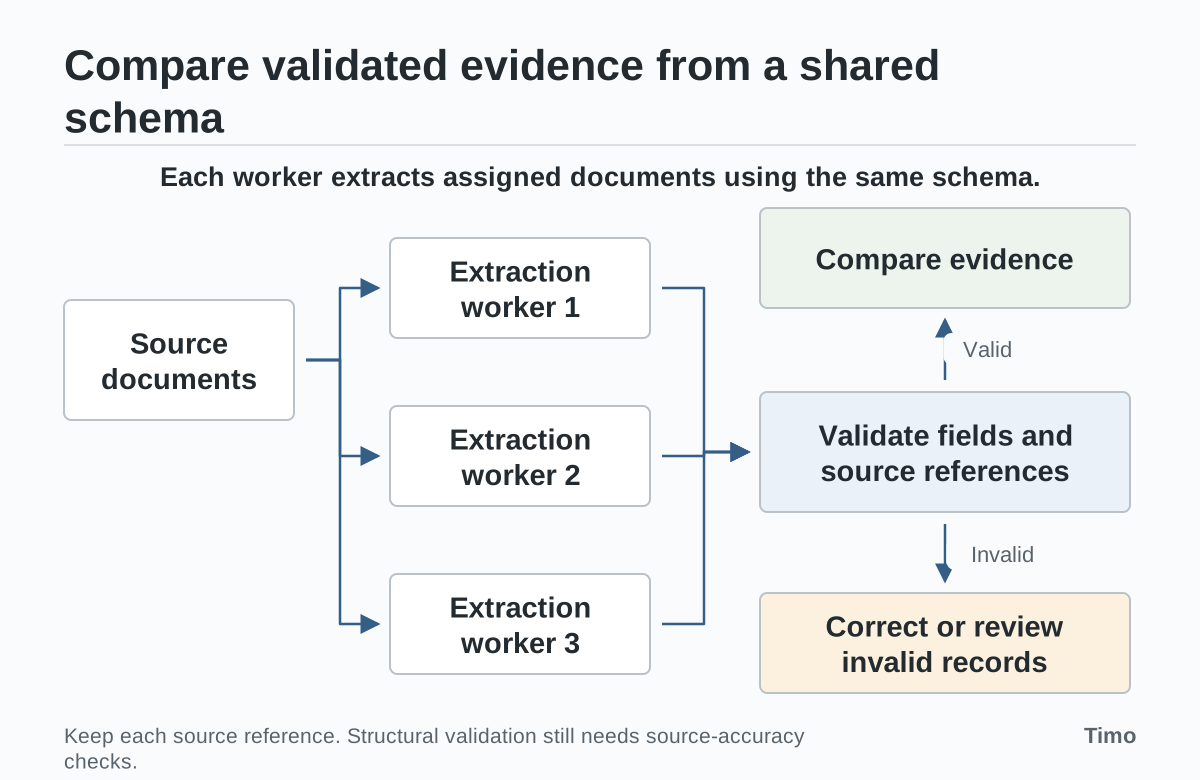
This known set of document tasks can start with a fixed workflow; it does not require a model to invent the task plan. Anthropic’s agent architecture guidance distinguishes predefined parallel work from an orchestrator that decides the subtasks dynamically. Choose the additional orchestration only when the task actually needs it.
Practice question 2: designing an MCP boundary
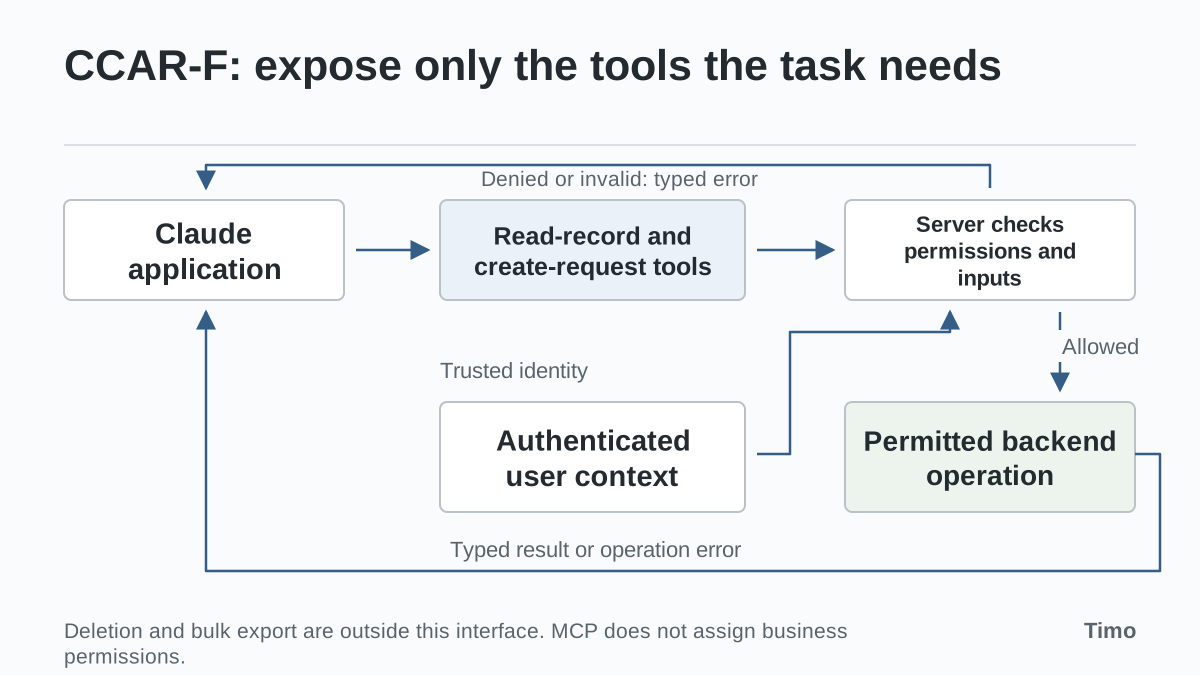
An internal Claude application needs to read approved customer records and open a service request. Its backend also exposes account deletion and bulk export operations, which are outside this application's responsibility. Staff may view only the customers in their own region, and each record includes free-text notes written by customers, which the model reads.
The team is using Model Context Protocol (MCP), a standard way for AI applications to connect to tools and data. An MCP server can expose operations to the application, but the protocol does not decide which business permissions the user should have. Which design best limits the tool access to the task?
Show answer and explanation
Best answer: D. The tool surface, the operations the agent can request, should match the application's job. A read-record tool and a create-request tool give each action a clear purpose, input format, and result. They do not give this assistant a reason or a means to invoke deletion or bulk export.
User-scoped authorization means the service checks the requested operation against the permissions of the authenticated user. Server-side validation means trusted service code checks the request before performing the operation or returning protected contents. These controls remain effective even if a model produces a mistaken request. Typed errors give the caller a distinct result for a permission failure, invalid input, or temporary outage so it can choose the appropriate recovery.
The read and creation operations may need different rules. A user entitled to view a record is not automatically entitled to create every type of service request. The implementation must enforce each operation's actual permissions rather than treating connection to the MCP server as blanket approval.
Why the alternatives are weaker: A keeps deletion and bulk export reachable through the general tool. A system prompt instruction guides the model but does not block a call, and the model also reads customer-written notes that could ask it to do something else. B correctly keeps the user's identity, but every read operation includes bulk export, which is outside this application's job. The confirmation step covers request creation only. C narrows the tool names, but the shared service account can read customers in every region. Trimming fields afterwards still lets a user receive a record from another region, because the permission is not checked at the point of access.
The MCP tools specification requires servers to validate inputs and enforce access controls. Test those controls by calling the server directly with a forbidden operation or another test user’s record ID, rather than relying only on what the model chooses to request. A confirmation dialog does not give the user permissions they lack.
For create_request, test one more failure: the backend creates the request but the reply is lost. A retry can create a duplicate. Use a stable operation identifier for the same intended request, and have the backend recognise a repeat and return the existing result. That property is called idempotency. It requires application and storage logic; a narrow MCP tool name does not provide it automatically.
Practice question 3: reviewing a large code change
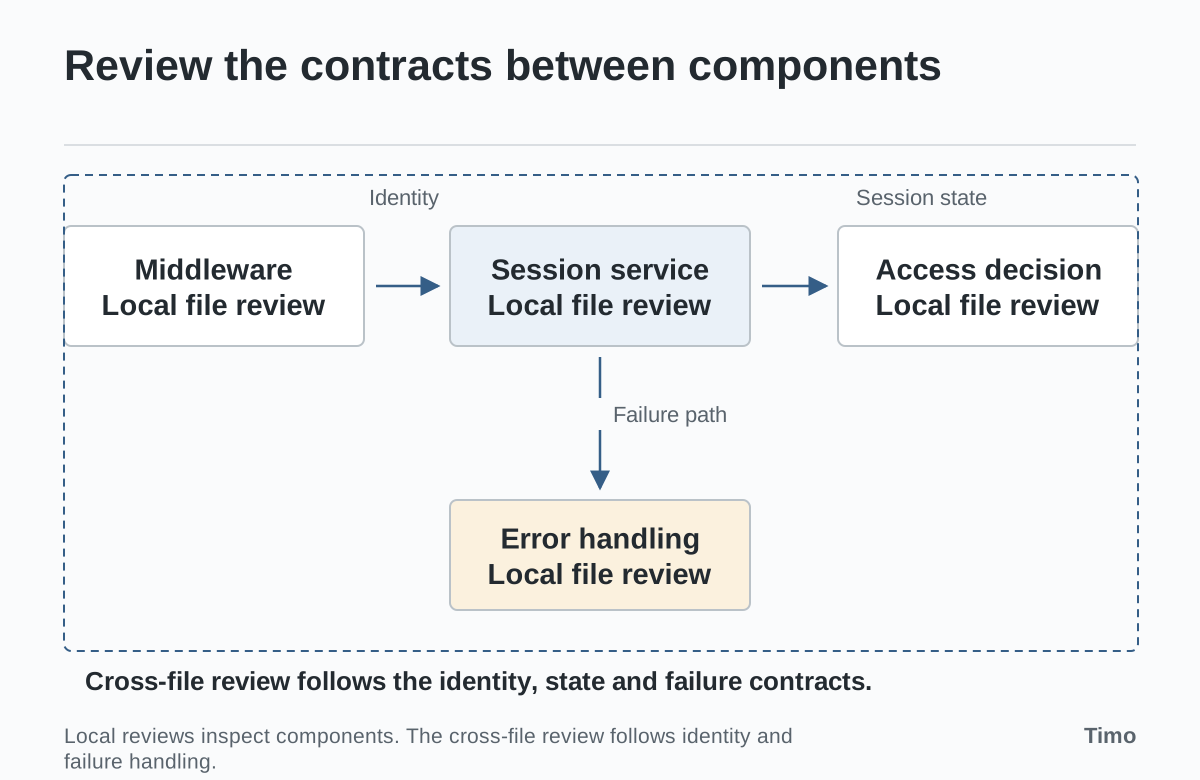
A team uses Claude Code to review a migration that changes authentication logic across many files. Reviewing each file separately has found local defects, such as a function that does not check its input. Every previous review, however, missed an invalid transfer of identity information between middleware, which processes incoming requests, and the service that manages signed-in sessions. Neither side of that transfer looked wrong on its own.
The team needs findings on the individual files and on the complete identity path from incoming request to access decision. Which workflow best meets that need?
Show answer and explanation
Best answer: A. A file-level review can inspect whether an individual function validates its input and handles errors. It may not reveal that another component calls the function with a different assumption. The integration review follows the actual path from request handling through session lookup to the final access decision.
For example, one file may represent an expired session as an empty value while another interprets that value as permission to continue without a session. Each function can appear internally consistent while their combination produces the wrong result. A cross-file review must inspect those contracts and transitions directly, including what happens when the session service fails.
Record local findings with enough context to locate and verify them, then use the integration pass to inspect the relationships. A targeted test of the identity path provides stronger evidence than a collection of favourable file summaries.
Why the alternatives are weaker: B ranks the findings the file reviews already produced, and none of them covers the transfer that previous reviews missed. File summaries do not show how the middleware and the session service use each other's values. C gives each component a clear owner, but the missed defect sits between the middleware and the session service, and each side looked correct on its own. D adds a second opinion, but agreement is not proof of correctness. Setting aside findings that only one review reports can discard a real defect, and neither review is directed at the identity path where the known risk lies.
How to review your result
After each question, write a short architecture decision record: a note that names the requirement, the chosen design, the strongest alternative, and why the choice fits the constraints. Avoid stopping at broad adjectives such as “secure” or “scalable.” State which operation is unavailable, which evidence is retained, or which failure the design can detect.
For the supplier exercise, a useful record explains why the shared schema matters, how missing source references are rejected, and when a reviewer must inspect conflicting passages. It should also acknowledge the cost: extraction, validation and comparison are additional steps that must be maintained. Their value lies in the comparability and traceability the original design lacked.
Make the architecture testable
Use this fictional supplier record to test what reaches the comparison step. Both passages refer to the same supplier and service. The contract requires 30 days’ termination notice; an amendment says 60 days, but its effective date has not been confirmed.
| Worker result | Coordinator decision | Reason |
|---|---|---|
| 30 days; contract v1, section 8; termination notice | Accept as sourced evidence. | The value, meaning and source are identified. |
| 60 days; amendment v2, section 2; effective date unknown | Preserve a conflict for review. | A newer filename does not establish which term is in force. |
| 60 days; no source location | Reject the extraction and request evidence. | A value alone cannot be checked. |
| No result; worker timed out | Mark comparison incomplete. | Missing work provides no evidence that the supplier has no risk. |
The coordinator needs an explicit completion rule. Record each required document, its extraction status and the checks it passed. A complete comparison requires a valid result for every required document, or an explicitly approved exclusion with its reason. An unresolved contradiction must remain visible in the output. Application checks should prevent a “complete, no conflicts” result while a required task is missing or a conflict record remains open.
Make a deliberate failure: remove the amendment result after the worker was assigned. The expected outcome is “incomplete: amendment missing,” even if the remaining summary sounds convincing. Restore it with the 60-day value and expect a visible conflict; silently choosing the larger number would fail the test. These are proposed test outcomes. No agent run is reported here.
Apply the same method to question 3. On a protected route, test valid, expired and unavailable-session states through middleware, the session service and the final access decision. An expired session and an unavailable session service have different causes, but neither is permission to return protected data. Capture the component states and the final response so another developer can locate an incorrect transition.
The Claude certification readiness checklist can help you choose further resources that explain architecture decisions under explicit constraints.
Register for the CCAR-F exam · how to get Claude certified
CCAR-F practice exam FAQs
Is this an official CCAR-F practice exam?
No. Timo wrote these original questions independently. Anthropic has not supplied, reviewed, or endorsed them.
Are these questions copied from an exam guide?
No. The guide informs the role scope; the scenarios and answer options were developed independently. They do not reproduce live or protected assessment content.
How is this different from developer practice?
The emphasis here is on the relationships among components: how work is divided, what crosses a boundary, and how the complete system behaves when a part fails. Implementation knowledge supports that reasoning, but the design must account for the whole workflow.
Do I need multiple agents for every architecture exercise?
No. Use the smallest design that satisfies the requirement. These questions include cases where dividing work is useful, but extra agents add coordination and validation work that must be justified.
Can a set of sample questions predict my exam result?
No. It cannot represent the full blueprint or reproduce official assessment conditions. Use it to identify design assumptions you need to examine further.
How can Timo help me prepare for CCAR-F?
Use these worked questions and the linked Architect Foundations study guide to practise source-backed extraction, narrow tools and cross-component review. Keep a decision record and tests that expose missing evidence or a failed dependency.
For Timo’s learning route, read the current enrollment, agreement and account process, then submit your profile for review. Enrolled consultants sign a consulting agreement with Amotion AI, which is Certified in the Claude Partner Network, register for their Claude exam with their Amotion AI consultant email, and use their expert profile and Timo Scout AI to find enterprise AI projects. Provider eligibility and exam requirements still apply; completing Timo practice does not award an Anthropic credential.
How many questions are on the CCAR-F exam?
The CCAR-F exam has 60 questions in 120 minutes. You need a scaled score of 720 out of 1,000 to pass.
How do I book the CCAR-F exam?
Register and pay in Anthropic Partner Academy with a Claude Partner Network account, then book with Pearson VUE. See the registration steps.
Latest Claude jobs
224 open jobs ask for Claude skills. Updated 6 Nov 2026.
- AI Operations EngineerCoast
$150k to $180k a year
AI agentsLLMs and generative AIMCPEvaluations
- AI Engineer (Brilliant Harvest)AltaML
AI agentsLLMs and generative AIRAG and retrievalMCP
- AI Engineer (CCC Auto / Agentic)EvolutionIQ
$170k to $195k a year
AI agentsLLMs and generative AIMCPEvaluations
- AI Product EngineerCapco
AI agentsLLMs and generative AIRAG and retrievalPrompt engineering
- AI Product EngineerCapco
AI agentsLLMs and generative AIRAG and retrievalPrompt engineering