 By Amotion AI
CCAO-F · Free practice exam · No sign-up
Claude Certified Associate Foundations practice exam (CCAO-F)
Take a free 20-question practice exam for Claude Certified Associate Foundations (CCAO-F) in 40 minutes. You get your score, results by topic and an explanation for every answer option.
Loading your practice exam…
Employer not a Claude partner?
If your employer is not a Claude partner but you want to become Claude certified, enroll with Timo.
Enroll with TimoCovers: Everyday Claude use, responsible AI and practical business workflows.
From practice to certified
Practise free
Take the free 20-question CCAO-F practice exam. No sign-up.
Enroll with Timo (paid)
Enrolled users get 1,180 practice questions in 20 full-length mock exams, plus OpenAI partner courses and badges.
Book your exam
As a Timo consultant, you register for all four Claude certification exams under Amotion AI, which is Certified in the Claude Partner Network. You pay the exam fee to Anthropic.
Independent Timo preparation material. This is not an official exam and is not supplied or endorsed by Anthropic. A practice score is not a prediction of passing.
What the 20 questions cover
| Official domain | Official weight | Free questions |
|---|---|---|
| 1. Prompting and Task Execution | 14% | 2 |
| 2. Output Evaluation and Validation | 21% | 3 |
| 3. Product and Model Selection | 12% | 3 |
| 4. Workflow Integration and Solution Design | 16% | 3 |
| 5. Configuration and Knowledge Management | 12% | 3 |
| 6. Governance, Risk, and Responsible Use | 15% | 3 |
| 7. Troubleshooting and Optimization | 10% | 3 |
| Total | 100% | 20 |
Study each topic: CCAO-F study guide.
This free set does not follow the official domain weights. The table shows the actual number of questions in each domain.
Claude Certified Associate Foundations exam guide
The official exam has 60 questions in 120 minutes and a pass mark of 720 on a 100 to 1,000 scale.
All 20 CCAO-F practice questions with answers
These are the same 20 questions as the practice exam above. Take the timed practice exam first, then use this list to check each answer and its source.
Show all 20 questions
-
Question 1
4. Workflow Integration and Solution Design
A product team uses Claude to analyze 400 exit-survey comments and support tickets to learn why customers abandon the sign-up flow in its mobile app. The results will decide which steps of the flow get redesigned, so other teams must be able to check and challenge them. Which two practices give the team a sound basis for those decisions?
Choose two.
Show answer and explanation
Answer: B and D
Reasoning. Research that drives process changes must be checkable: findings need to trace back to their evidence, and observed facts must be kept apart from Claude's interpretations.
Why A is incorrect. Merging Claude's guesses with what customers reported hides which items are evidence and which are interpretation, so other teams cannot challenge them properly.
Why B is correct. Separating customer reports from Claude's interpretations lets the team see which conclusions rest on evidence and which still need testing.
Why C is incorrect. Looking only at the steps already chosen for redesign can miss other causes of abandonment, which defeats the purpose of deciding what to redesign.
Why D is correct. Linking each finding to its source comments lets other teams check whether the evidence really supports it.
-
Question 2
2. Output Evaluation and Validation
A lender uses Claude to draft a risk summary for each loan application. For one application, Claude's summary recommends rejection. The lender's policy says only an authorized lending officer may decide an application, using the lender's approved credit criteria. What should happen next?
Show answer and explanation
Answer: C
Reasoning. Decisions with serious consequences for people must be made by the accountable person the organization has authorized, not by Claude.
Why A is incorrect. A recheck by Claude, even against a checklist, is not a decision by an authorized officer using the approved criteria.
Why B is incorrect. Agreement between two models does not give either of them the authority the policy reserves for a lending officer.
Why C is correct. The policy gives the decision to an authorized officer, who can assess the evidence against the approved criteria.
Why D is incorrect. Citations show where the summary's points came from, but the policy still requires an authorized officer to make the decision.
-
Question 3
3. Product and Model Selection
Last quarter a legal-operations team used one Claude model for a complex contract review and was pleased with the results. The team now wants to choose a standard model for this work. Since last quarter, newer models have been released and the contracts under review have changed. What should the team do before deciding?
Show answer and explanation
Answer: B
Reasoning. A standard model choice should be based on testing current models against representative current work, not inherited from one past success.
Why A is incorrect. Price alone does not show whether a model meets the quality this complex review needs.
Why B is correct. Testing current models on current contracts gives direct evidence for the choice, given that both have changed.
Why C is incorrect. Another department's choice does not show that the model suits this team's contract work.
Why D is incorrect. Last quarter's result does not show how that model compares with newer models on the contracts the team now reviews.
Source: docs.anthropic.com
-
Question 4
5. Configuration and Knowledge Management
A procurement team works in a shared Claude Project. In every chat in the Project, Claude must state its assumptions and must never invent an approval date that is missing from the documents. Where should the team put this rule so it applies to every chat?
Show answer and explanation
Answer: D
Reasoning. Standing rules that should govern every chat in a Project belong in the Project instructions.
Why A is incorrect. Claude does not have access to the Project description, so a rule written there would not guide any chat.
Why B is incorrect. The calendar should supply the dates themselves; hiding a behavior rule inside reference material is less clear and less reliable than stating it in the instructions.
Why C is incorrect. A message in one chat is not a standing rule; a Project does not share one chat's context with later chats, so they would not reliably follow it.
Why D is correct. Project instructions set standing behavior for every chat in the Project, which is what this rule needs.
Source: support.claude.com, support.claude.com
-
Question 5
7. Troubleshooting and Optimization
A legal team piloted Claude for contract reviews and reported that review time fell. However, the pilot handled mostly simple contracts, while the old process handled many complex ones, and reviewers corrected some pilot errors after the reviews had been sent. Which two measures give the fairest comparison of speed and quality between the pilot and the old process?
Choose two.
Show answer and explanation
Answer: A and C
Reasoning. A fair comparison uses similar workloads and the full work cycle, measuring time and quality within the same boundaries.
Why A is correct. Matching contract complexity and including rework stops the easier workload and the later corrections from creating a false time saving.
Why B is incorrect. First-draft time ignores the later corrections and compares two very different mixes of contracts.
Why C is correct. Counting errors over the same period for similar contracts catches the problems found after reviews were sent.
Why D is incorrect. First-reading acceptance misses the errors that were only found and corrected after the reviews went out.
-
Question 6
6. Governance, Risk, and Responsible Use
A bank's regulator approved a secure environment where Claude analyzes customer transaction records for one purpose: detecting fraud. The marketing team now wants to use the same records, in the same environment, to build customer profiles for targeted offers. What is the best response?
Show answer and explanation
Answer: A
Reasoning. Approval to handle data depends on the purpose and scope approved, not only on where the data is processed.
Why A is correct. Marketing is a new purpose, so it needs its own authorization and a check of which data it may use.
Why B is incorrect. Removing names does not extend the fraud approval to marketing, and transaction data can still identify people.
Why C is incorrect. The approval covers fraud detection, not every use of data held in that environment.
Why D is incorrect. Reviewing the profiles does not give permission to process the records for a new purpose.
-
Question 7
1. Prompting and Task Execution
A project coordinator has notes from a 90-minute planning meeting and needs a list of follow-up tasks to track. Some tasks in the notes have no named owner or deadline. Which prompt gives Claude the clearest task?
Show answer and explanation
Answer: A
Reasoning. A clear prompt defines the deliverable and says how to handle information that is missing from the source.
Why A is correct. This defines exactly the fields the coordinator needs and stops Claude from inventing owners or deadlines that are not in the notes.
Why B is incorrect. Topics and conclusions do not identify who must do what, or by when.
Why C is incorrect. A paragraph may capture decisions, but it does not require an owner and due date for each action.
Why D is incorrect. A recap of what each person said does not turn the discussion into tracked actions with owners and dates.
-
Question 8
4. Workflow Integration and Solution Design
A hospital IT team built a prototype Claude assistant that reads staff service requests and routes each one to the right department. In testing it routes single-department requests correctly, but a request that needs two departments, such as a new starter who needs both a laptop and building access, goes to only one of them. The team wants routing to work for all request types before launch. What should it do next?
Show answer and explanation
Answer: C
Reasoning. Design iteration should target the failure the testing revealed, using representative test cases to check the revision.
Why A is incorrect. A bigger pilot with the same routing rules would repeat the known failure rather than fix it.
Why B is incorrect. Launching now ignores the stated goal that routing must work for all request types, including two-department requests.
Why C is correct. The failing two-department cases show exactly what to fix, and test cases let the team confirm the revised routing works.
Why D is incorrect. Showing the department helps staff spot errors, but the requests would still be routed wrongly.
-
Question 9
2. Output Evaluation and Validation
A finance analyst asks Claude to compare March and April sales totals, and Claude reports a 17.6% increase. The figure will go into a report for the leadership team, so it must be correct. What should the analyst do before using it?
Show answer and explanation
Answer: D
Reasoning. Numbers produced by Claude should be checked by recalculating them independently from the source data.
Why A is incorrect. The summary came from the same draft, so it may simply repeat the same error.
Why B is incorrect. Last year's growth only shows whether 17.6% looks plausible; it does not check this year's calculation.
Why C is incorrect. Another answer from Claude is not an independent check against the source totals.
Why D is correct. Recalculating from the source totals directly confirms whether 17.6% is right.
-
Question 10
3. Product and Model Selection
A consultant is writing a 20-page onboarding playbook for a client with Claude's help. The playbook will go through several rounds of client review, and the consultant wants one standalone document that is revised in place each round. Which Claude feature fits best?
Show answer and explanation
Answer: C
Reasoning. Choose the feature that matches the deliverable: a substantial document revised over time suits an artifact.
Why A is incorrect. Chat replies produce a new copy each time, so there is no single document being revised.
Why B is incorrect. Account-wide instructions shape Claude's general behavior in every chat; they are not a place to write and revise a deliverable.
Why C is correct. An artifact holds a substantial standalone document that Claude can revise across rounds.
Why D is incorrect. Uploading each draft leaves several versions side by side instead of one document revised in place.
Source: support.claude.com
-
Question 11
5. Configuration and Knowledge Management
An analyst wants to connect Claude to the team's shared drive so Claude can search project files. The drive holds both general project folders and restricted HR folders, and company policy lists which data may be used with AI tools. Which two checks should the analyst make before using the connector?
Choose two.
Show answer and explanation
Answer: C and D
Reasoning. Before using a connector, check both what it can technically reach and whether the intended data use is approved.
Why A is incorrect. Full access would include the restricted HR folders, which is the opposite of what the analyst should aim for.
Why B is incorrect. A prompt instruction does not limit what the connector can reach, so the HR files would still be accessible.
Why C is correct. Knowing the connector's real access shows whether the restricted HR folders are within reach.
Why D is correct. The policy decides which data may be used with AI tools, so the intended use must be approved.
Source: support.claude.com
-
Question 12
7. Troubleshooting and Optimization
An HR team set up a Claude assistant that answers staff questions using the company's policy manual. For common questions it answers correctly and cites the manual, but when a question is not covered by the manual, it makes up an answer. Which two changes directly address this failure?
Choose two.
Show answer and explanation
Answer: C and D
Reasoning. Fixing this failure needs both a clear rule for what to do when the manual has no answer and tests that check the rule works.
Why A is incorrect. Examples of topics the manual covers do not show the assistant what to do when a topic is missing.
Why B is incorrect. Web results are not company policy, so answers would still not be grounded in the manual.
Why C is correct. This tells the assistant exactly how to behave when the manual has no answer, instead of guessing.
Why D is correct. Questions with no answer in the manual show whether the assistant now admits the gap in practice.
-
Question 13
6. Governance, Risk, and Responsible Use
An operations manager is choosing a first use of Claude from four proposals. Outputs will get ordinary staff review: a team member reads them for accuracy and tone, with no specialist check. Which proposal suits this level of review?
Show answer and explanation
Answer: D
Reasoning. Match the use to the review available: ordinary staff review suits low-risk, easily checked tasks, not high-impact decisions.
Why A is incorrect. An office manager cannot check whether a medical diagnosis is correct.
Why B is incorrect. Child-protection decisions need specialist judgment; checking the wording cannot catch a wrong decision.
Why C is incorrect. Redundancy rankings have serious consequences for employees and need safeguards well beyond an ordinary read-through.
Why D is correct. Summarizing approved feedback is low-risk, easy to check and correct, and fits ordinary staff review.
-
Question 14
1. Prompting and Task Execution
A manager asks Claude to help produce a board memo recommending whether to open a second warehouse. The work involves researching costs, analyzing options, forming a recommendation and writing the memo. The board expects every figure in the memo to be backed by evidence. What is the best first step?
Show answer and explanation
Answer: C
Reasoning. Breaking a complex deliverable into stages makes each part reviewable before later work depends on it.
Why A is incorrect. Reviewing only the recommendation can miss weak research or wrong figures earlier in the memo.
Why B is incorrect. The most convincing memo is not necessarily the one with the best-supported figures.
Why C is correct. Checking each stage lets the manager confirm the research and figures before they shape the recommendation.
Why D is incorrect. A template helps the layout, but it does not make sure the figures are backed by evidence.
-
Question 15
4. Workflow Integration and Solution Design
New hires at a logistics company report waiting up to two weeks for laptops, system access and training. The HR director asks a project team to redesign onboarding with Claude's help. What should the team establish before proposing changes?
Show answer and explanation
Answer: B
Reasoning. Redesign work starts by understanding the current process, its constraints and the measurable improvement needed.
Why A is incorrect. The easiest steps to automate may not be the ones causing the delays new hires report.
Why B is correct. Understanding the current process, its limits and the target improvement shows where the two-week delays come from.
Why C is incorrect. Choosing a pilot department comes later; it does not explain what is causing the delays.
Why D is incorrect. The delays are in laptops, access and training, so model response speed does not address them.
-
Question 16
2. Output Evaluation and Validation
Before a quarterly sales report drafted by Claude goes to executives, a reviewer checks it against the source files. Which two findings are clear warning signs that the report needs correction?
Choose two.
Show answer and explanation
Answer: A and C
Reasoning. Made-up references and figures that contradict each other are clear signs the output must be corrected before use.
Why A is correct. A reference to a section that does not exist suggests the citation was made up.
Why B is incorrect. Leaving out product lines the request excluded is following instructions, not an error.
Why C is correct. Two different revenue totals in one report mean at least one of them is wrong.
Why D is incorrect. Paraphrasing the source is normal; it is only a problem if the meaning changes.
-
Question 17
3. Product and Model Selection
A market analyst needs a summary of the price changes five competitors announced this month, with a citation for each claim. Which Claude feature should the analyst use?
Show answer and explanation
Answer: D
Reasoning. When the task needs current external information with citations, use a feature that can research the web.
Why A is incorrect. A summary built from earlier material does not show what competitors announced this month.
Why B is incorrect. An instruction to cite sources does not give Claude access to this month's announcements.
Why C is incorrect. Last quarter's notes cannot contain this month's price changes.
Why D is correct. Web search gives Claude access to current pages and lets it cite them, which meets both needs.
-
Question 18
5. Configuration and Knowledge Management
A customer-service team shares a Claude Project whose knowledge files and instructions reflect policies that change every quarter. Last quarter, Claude kept quoting an old refund limit for weeks after the policy changed. Which two maintenance practices best prevent stale guidance?
Choose two.
Show answer and explanation
Answer: A and B
Reasoning. Shared guidance stays current when someone owns regular reviews and every replacement is recorded.
Why A is correct. A named owner with a quarterly review catches outdated files and instructions when the policies change.
Why B is correct. A replacement log shows which source is current and makes each change traceable.
Why C is incorrect. Old policy files left in the Project give Claude conflicting guidance, which is how the old refund limit kept appearing.
Why D is incorrect. Relying on each person to correct Claude in chat is inconsistent and leaves the outdated files in place.
-
Question 19
7. Troubleshooting and Optimization
A consulting team has a Claude Project for one client. In every new chat, staff paste in the client's glossary of terms and the client's formatting rules. The team wants to stop this repeated pasting without the client's rules affecting their work for other clients. What should they change?
Show answer and explanation
Answer: D
Reasoning. The fix should remove repeated setup while keeping the rules scoped to the one client they belong to.
Why A is incorrect. Account-wide instructions apply to all of a staff member's chats, so this client's rules would affect work for other clients too.
Why B is incorrect. Staff would still paste the same material into every chat, which is the step the team wants to remove.
Why C is incorrect. Relying on one long chat is not a durable setup, and it does not make the rules available to new chats.
Why D is correct. Project knowledge and instructions apply to every chat in this client's Project and nowhere else.
Source: support.claude.com, support.claude.com
-
Question 20
6. Governance, Risk, and Responsible Use
A communications department wants Claude to take on more routine work. Department policy says Claude may help with tasks whose outputs a person reviews and can easily correct, while serious decisions and access approvals stay with authorized staff. Which two tasks fit this policy?
Choose two.
Show answer and explanation
Answer: A and D
Reasoning. Reviewable drafting and analysis can be delegated to Claude; serious decisions and access approvals cannot.
Why A is correct. Draft headings are easy for a person to review and change, so this fits the policy.
Why B is incorrect. Ending a contract over alleged fraud is a serious decision that needs an investigation and an authorized decision-maker.
Why C is incorrect. Access to restricted records is an approval that stays with authorized staff under the policy.
Why D is correct. An analyst reviews the draft themes and can correct them, so this fits the policy.
Free practice vs paid Timo enrollment
| Feature | Timo | Practice-only sites |
|---|---|---|
| Free 20-question practice exam, no sign-up | Free | Varies |
| Full-length mock exams for all four Claude certifications | With paid enrollment: 20 exams, 1,180 questions | Varies |
| Register for official Claude exams | With paid enrollment: you register under Amotion AI, which is Certified in the Claude Partner Network | Not offered |
| OpenAI learning | With paid enrollment: OpenAI partner courses and badges for ChatGPT, Codex and API | Not offered |
| Expert profile and job matching | With paid enrollment | Not offered |
Timo is a brand of Amotion AI. Amotion AI is Certified in the Claude Partner Network and an OpenAI Select Partner.
Claude exam fees are paid separately to Anthropic when you book an exam. Joining Timo does not guarantee certification, a project or income.
Enroll to get 5 full-length CCAO-F mock exams100+ Claude and OpenAI certified and ready for AI work through Timo




Sample questions with explanations
This section has three original worked sample questions for Claude Certified Associate – Foundations (CCAO-F). Each asks you to choose the best action under stated conditions. Try answering before reading the explanation, then compare the reason behind your choice with the reason the recommended action works.
A manager receives a clear, confident brief from Claude. The writing is ready to circulate, but one conclusion goes further than the evidence allows. Knowing what to do next is the kind of judgement useful CCAO-F mock exam practice should develop: how to use an AI draft, check its claims, and keep responsibility for the business decision clear.
These are independent practice questions, not official Anthropic questions, recalled exam material, a full timed exam, or a prediction of your result.
Timo is run by Amotion AI. These original Associate practice questions focus on checking evidence, applying business rules and improving a team’s use of Claude.
What you are practising at Associate level
CCAO-F focuses on applying Claude to business and productivity work. The official CCAO-F exam guide covers prompting, output validation, product and model choice, workflow design, knowledge management, governance, and troubleshooting. The Timo Associate Foundations guide provides an overview of the role.
In everyday terms, this means giving Claude a clear task, supplying appropriate information, checking what it produces, and deciding when a person must resolve an uncertainty. A workflow is the repeatable sequence that connects those activities. For example, a weekly supplier update might move from current policy and delivery data to an AI draft, a manager's checks, and an approved message.
You do not need to design the software behind that sequence to reason about its quality. You do need to notice when an old policy, a missing comparison, or an unclear review rule makes the result unreliable. The three questions below examine those problems in turn.
Practice question 1: validating a management brief
A programme manager asks Claude to prepare a one-page decision brief from a policy manual, a spreadsheet of current results, and notes from three stakeholder interviews. The brief will help a director decide whether to extend a policy change to more teams. Whether the change reduced processing time is central to that decision.
Claude writes that the change has already reduced processing time. The spreadsheet reports current processing times, but contains no before-and-after comparison. The supplied interview notes do not establish the reduction either. The company keeps other operational reports that were not given to Claude. The director must approve the brief before circulation, and has not yet done so. What is the best next action?
Show answer and explanation
Best answer: C. A current measurement tells the director what processing time is now. It does not establish whether processing time fell, or whether the policy caused any change. Those are additional claims, each requiring appropriate evidence.
The manager should flag the gap and check approved sources for a relevant comparison. If evidence exists, the brief should describe only what it supports. A before-and-after difference, for example, may show a change without proving that the policy caused it. If supporting evidence is unavailable, the revised brief should say the effect has not yet been established. The decision owner can then approve a brief that preserves the uncertainty instead of concealing it.
Why the alternatives are weaker: A adds a general caveat but leaves the specific claim in place. A busy director may still rely on it. B removes the error and keeps the director's review, but it drops the question central to the decision without looking in the company's other reports, which may hold the missing comparison. D changes the tone while keeping an unsupported trend. “Appears to be improving” still needs a before-and-after comparison, and none of the three sources contains one.
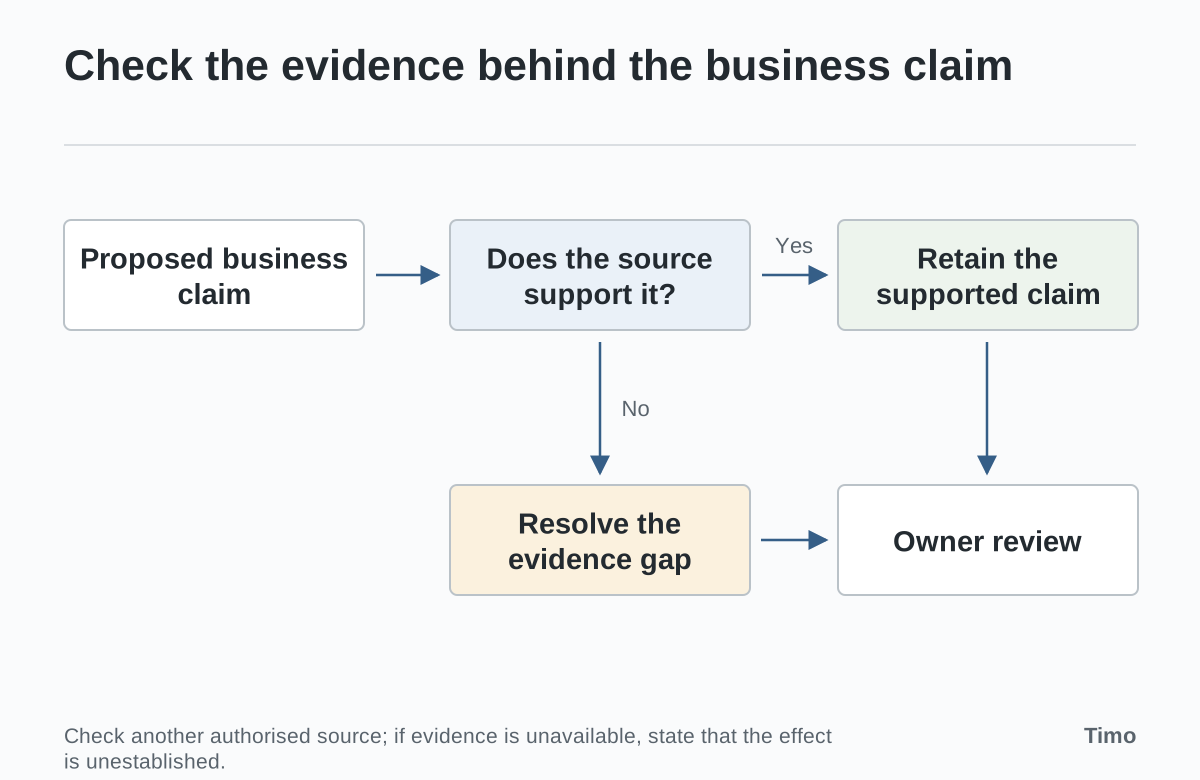
This sequence also tells you where Claude remains useful. The whole draft does not have to be discarded because one statement is wrong. You can keep supported content, correct the disputed passage, and ask for a revised brief that clearly separates established results from open questions.
Practice question 2: maintaining project knowledge
An operations team uses a Claude Project, a shared working space containing instructions and reference material, to draft weekly supplier updates. The Project contains last quarter's escalation policy, and its instructions summarise that policy's reporting thresholds. A newly approved policy changes which supplier delays must be reported to the finance director.
Several employees use the Project. The next update is due this week and has not yet been drafted. What should the workflow owner do first?
Show answer and explanation
Best answer: D. The people using the Project need one clear answer to “Which rule applies now?” Updating the reference material and the instructions makes that answer consistent. Retiring the old version means removing it from active use or unmistakably identifying it as historical; it does not require deleting the organisation's historical policy record.
The test is the final part of the change. Select a supplier delay whose required treatment is known under the new rule, particularly one handled differently under the old rule. Draft an update using that example and check whether it identifies the correct escalation. This checks the behaviour the team will depend on, rather than merely confirming that a file was uploaded.
Why the alternatives are weaker: A leaves both policies in the Project while the instructions still summarise the old thresholds, so Claude receives conflicting rules. A document date also does not prove which rule is in force. B depends on each of several employees pasting the new thresholds on every run, while the shared Project goes on stating the old rule. It might serve as a temporary workaround, but it does not fix the source. C corrects the instructions but keeps the old policy file in place for this week's update, which has not yet been drafted. The team can reconcile both before relying on the next output.
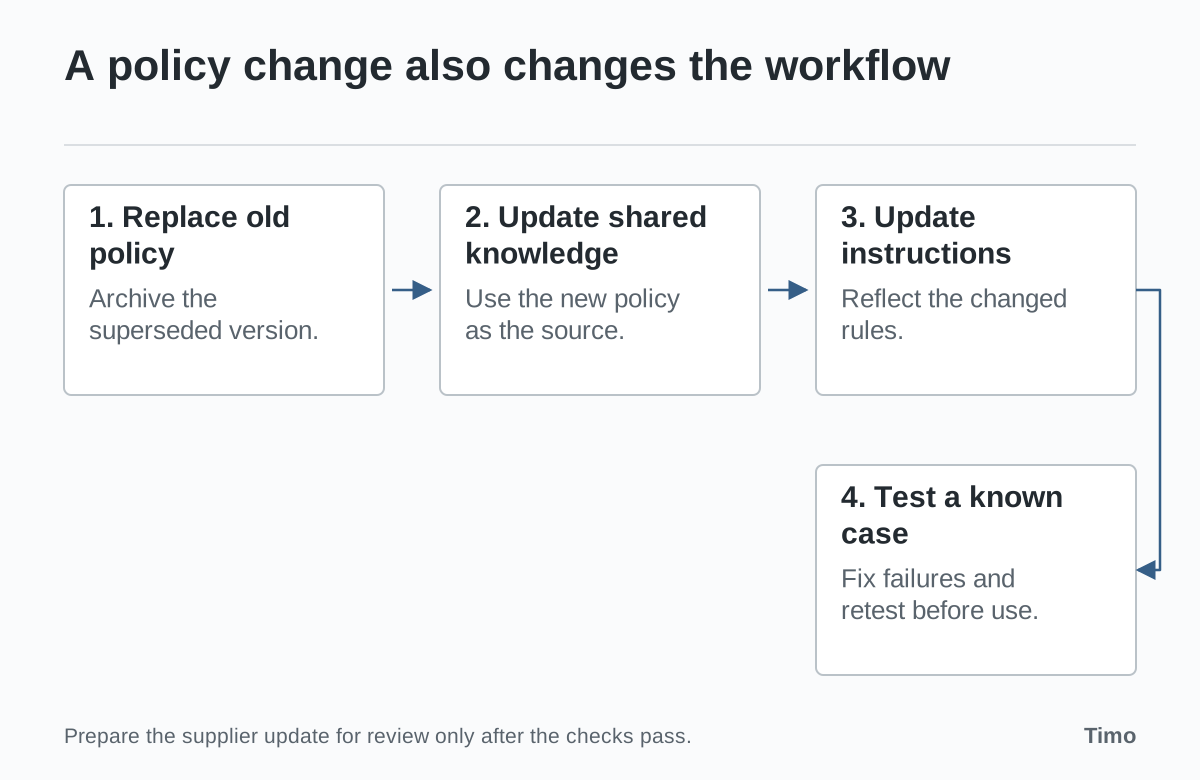
The lesson applies beyond supplier reporting. Whenever a shared AI workspace contains policies, templates, or procedures, someone must own their currency. Otherwise, an apparently repeatable workflow can repeat an outdated rule very efficiently.
Test a case that changes under the new policy
In this fictional test, the old policy escalates delays longer than five days; the new policy, effective today, escalates delays longer than three days. A six-day delay is escalated under both rules, so that test alone cannot reveal whether Claude used the old policy.
| Delay | Old rule | Current rule |
|---|---|---|
| Three days | Do not escalate. | Do not escalate: the rule says longer than three days. |
| Four days | Do not escalate. | Escalate. |
| Six days | Escalate. | Escalate. |
The four-day case detects use of the old threshold; the three-day case detects a boundary error. Ask the draft to identify the policy version and passage it used, then check that reference yourself. Run these cases in a fresh chat so earlier discussion does not obscure which instructions you are testing. Claude’s Project guidance explains that project knowledge and instructions apply across chats; updating one employee’s conversation does not update the shared knowledge.
Practice question 3: improving an inconsistent workflow
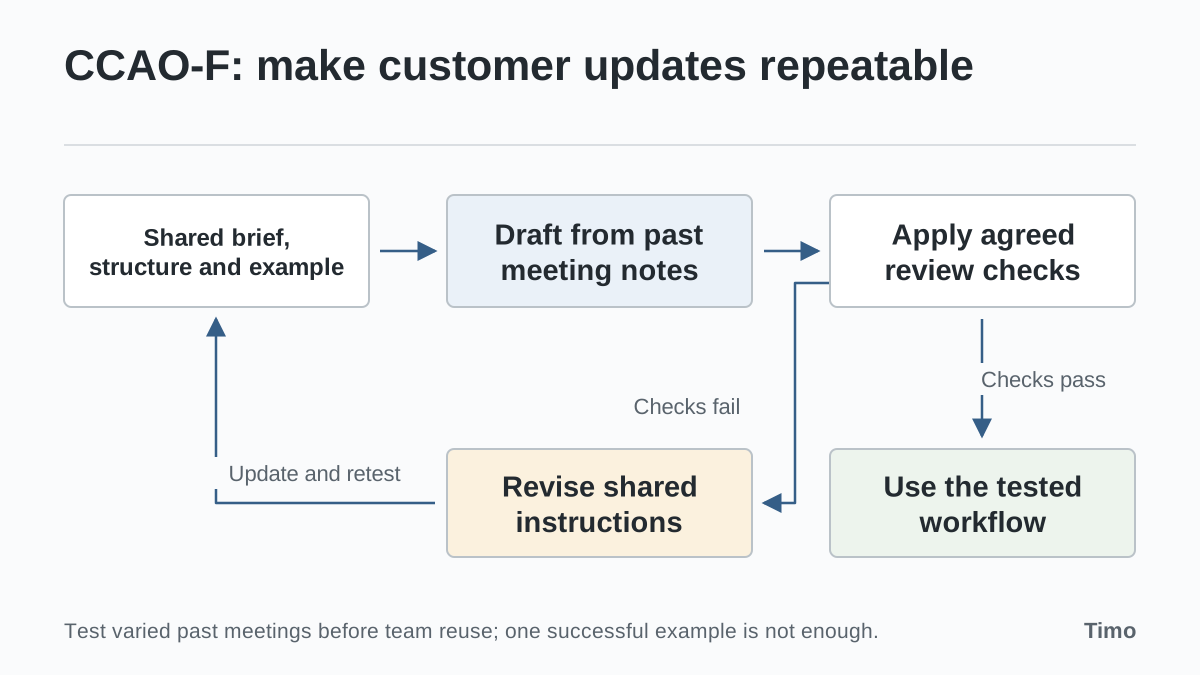
A communications team asks Claude to turn meeting notes into customer updates, about forty a week. Each employee supplies different instructions. Some updates distinguish confirmed commitments from suggestions; others present both as agreed actions. Editors also disagree about what a good update should contain. Which change is most likely to improve consistency?
Show answer and explanation
Best answer: A. The team first needs a common definition of the task and a common way to decide whether the result is acceptable. The brief can require the draft to use only the notes supplied. The structure can separate decisions, commitments, owners, and open questions. The approved example shows what those requirements look like in a finished update, while the checklist gives reviewers an agreed basis for accepting it.
Testing several past meetings matters because one polished example may be unusually easy. Include a meeting with an unassigned action and another with a proposal that was discussed but not approved. The workflow should preserve those distinctions. If it invents an owner or turns a proposal into a promise, the team has a specific problem to fix before reuse.
Why the alternatives are weaker: B reuses a prompt that worked for one meeting, but other meetings raise different problems, and the editors still disagree about what a good update contains, so review stays inconsistent. C may stop some wrong messages reaching customers, but one editor rewriting about forty drafts a week keeps correcting the same upstream problem. D gives everyone the same model and effort level, but those settings do not tell Claude which items are confirmed commitments, and they give editors no shared standard for an acceptable update.
How to review your result
For each question, write the action you chose, the evidence it depends on, and the person or check that makes it dependable. Then explain the strongest rejected option. If you chose B in question 2, for example, your underlying assumption may have been that everyone would remember to paste the latest policy. That assumption identifies something worth testing in a real team workflow.
Try this short fictional source note: “Ravi confirmed that he will send the revised schedule on Friday. A weekend cutover was suggested, but the customer has not approved it. The team needs a rollback plan; no owner was assigned.” Ask Claude for a customer update containing confirmed commitments, proposals awaiting approval and open actions.
| Source detail | Acceptable wording | Reject if the draft says |
|---|---|---|
| Ravi’s commitment | Ravi will send the revised schedule on Friday. | The schedule will be approved on Friday. |
| Weekend cutover | A weekend cutover is proposed and awaits customer approval. | The cutover is scheduled for the weekend. |
| Rollback plan | The rollback plan needs an owner. | Ravi owns the rollback plan. |
The table defines the expected review judgments. It does not report a Claude run. Keep your actual draft beside the source. If a sentence is wrong, record whether it invented a fact, changed the approval state or assigned an unsupported owner. Revise the instruction and rerun the original case, then try a new note with different names and an explicitly approved cutover. The new case checks whether the revision follows the evidence instead of always labelling every proposal as unapproved.
The Claude certification readiness checklist explains how to choose further preparation resources. Use practice questions to expose gaps, then return to the current provider guide and a practical exercise to address them.
Register for the CCAO-F exam · how to get Claude certified
CCAO-F practice exam FAQs
Is this an official CCAO-F practice exam?
No. The questions were written independently by Timo. Anthropic has not supplied, reviewed, or endorsed them.
Are these recalled questions from the live exam?
No. These are original workplace scenarios. They do not reproduce protected, recalled, or copied exam questions.
Is CCAO-F suitable for non-developers?
The role focuses on using Claude in business and productivity workflows. The exercises here ask you to judge sources, outputs and review decisions rather than build software integrations. Check the current provider guidance for your own preparation and eligibility.
What should I do if I chose the right answer for a different reason?
Compare your reasoning with the stated constraints. A correct letter can hide an assumption that would fail in a slightly different situation. Explain why each competing option leaves part of the problem unresolved, then try the same decision with one fact changed.
Will getting the three sample questions right predict a pass?
No. Three worked samples, or the 20-question practice exam, cannot represent the full exam blueprint or official testing conditions. Use the result to decide what to practise next.
How can Timo help me prepare for CCAO-F?
Use these worked questions and the linked Associate study guide to practise evidence checking, policy changes and customer-update review. Keep your source notes, revised output and the reason for each correction.
For Timo’s learning route, read the current enrollment, agreement and account process, then submit your profile for review. Enrolled consultants sign a consulting agreement with Amotion AI, which is Certified in the Claude Partner Network, register for their Claude exam with their Amotion AI consultant email, and use their expert profile and Timo Scout AI to find enterprise AI projects. Provider eligibility and exam requirements still apply; completing Timo practice does not award an Anthropic credential.
How many questions are on the CCAO-F exam?
The CCAO-F exam has 60 questions in 120 minutes. You need a scaled score of 720 out of 1,000 to pass.
Does the Claude Certified Associate certification expire?
Yes. It lasts 12 months. Anthropic describes renewal through a free, non-proctored assessment in Partner Academy.
How do I book the CCAO-F exam?
Register and pay in Anthropic Partner Academy with a Claude Partner Network account, then book with Pearson VUE. See the registration steps.
Latest Claude jobs
224 open jobs ask for Claude skills. Updated 6 Nov 2026.
- AI Operations EngineerCoast
$150k to $180k a year
AI agentsLLMs and generative AIMCPEvaluations
- AI Engineer (Brilliant Harvest)AltaML
AI agentsLLMs and generative AIRAG and retrievalMCP
- AI Engineer (CCC Auto / Agentic)EvolutionIQ
$170k to $195k a year
AI agentsLLMs and generative AIMCPEvaluations
- AI Product EngineerCapco
AI agentsLLMs and generative AIRAG and retrievalPrompt engineering
- AI Product EngineerCapco
AI agentsLLMs and generative AIRAG and retrievalPrompt engineering