
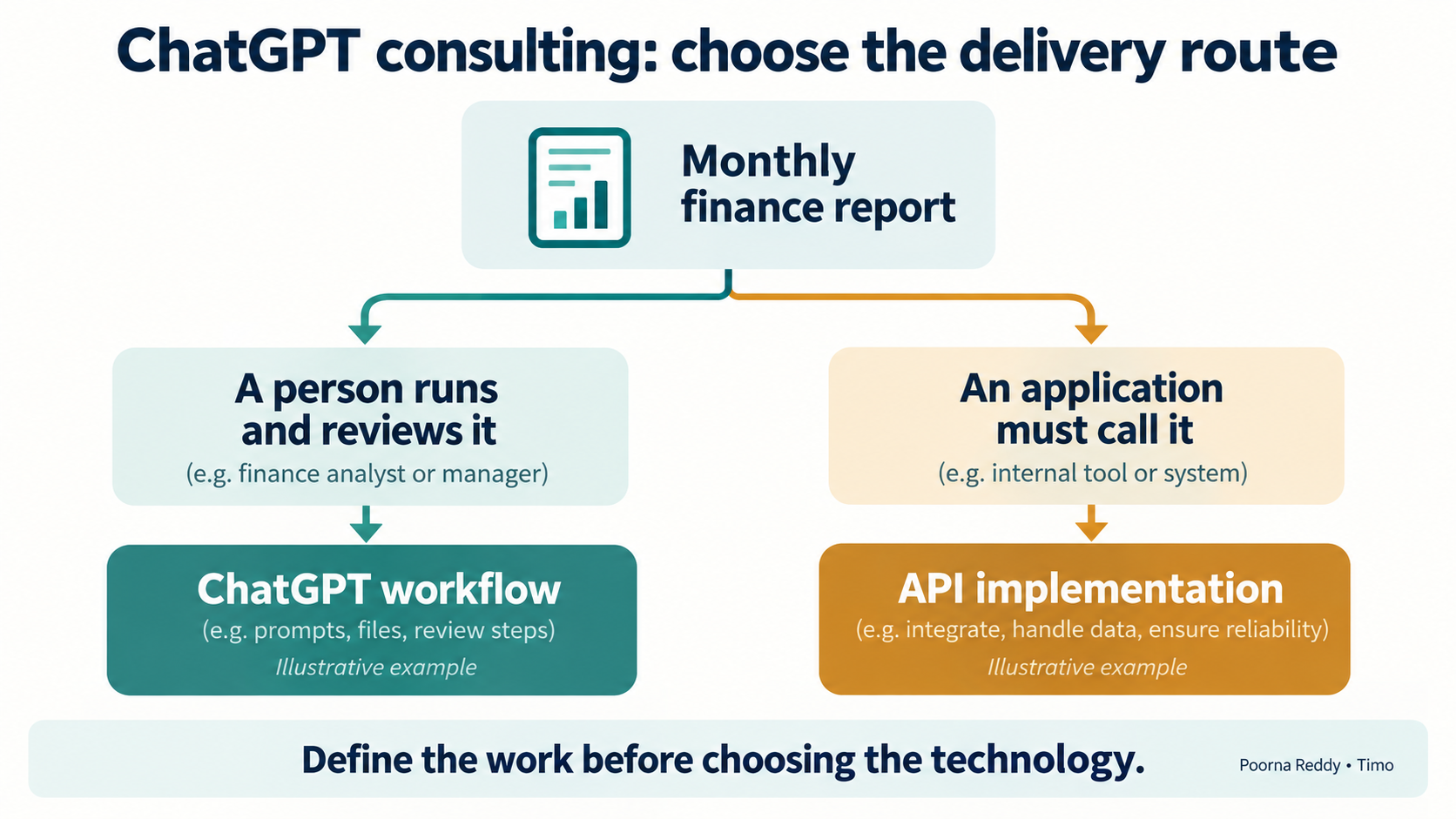
Start with one service: help a team use ChatGPT for an approved task, or build that task into software with the OpenAI API. An API is the connection that lets software send a request to an OpenAI model and receive its response. Your work sample should show the business task, permitted data, result, review check and owner.
A certificate can support learning, but there is no verified mandatory OpenAI certificate or partner status that automatically makes someone a consultant.
The practical route starts with one client problem. For example, a finance team may need a safer way to draft monthly variance commentary. A support team may need to improve its knowledge base before introducing an AI agent. Your value comes from turning that problem into a working process with clear inputs, controls, outputs and ownership.
Choose between team use of ChatGPT and custom software
First decide where the client will do the work. Many useful projects can run inside ChatGPT and do not need custom software.
ChatGPT training and setup helps people complete approved tasks inside the client's ChatGPT workspace. You select suitable tasks, prepare reusable instructions, improve the source documents, define how users will check answers, train the team and agree who can use or change the workspace. A person reviews and completes each piece of work in ChatGPT.
Custom OpenAI API work is appropriate when the client needs model capabilities inside an application or automated workflow. The OpenAI developer quickstart documents a programmatic interface, supported file inputs and tools that connect model output to application functions. A production implementation also needs software engineering, access control, logging, error handling, evaluation and ongoing operation.
Use this decision table before proposing a build:
| Client need | Likely starting route | Reason |
|---|---|---|
| A team wants help drafting, researching or analysing material under human supervision | ChatGPT adoption | The work can remain user-led while the team develops repeatable instructions and checks. |
| A company wants the same approved workflow available to many users inside an existing product | OpenAI API | The workflow needs software integration, controlled inputs and consistent application behaviour. |
| The task changes frequently and the team is still learning what good output looks like | ChatGPT pilot | A human-led pilot can define the process before anyone automates it. |
| The task is stable, high-volume and connected to business systems | Review the API need, then build a small prototype | Integration may be justified, but only after the team defines permissions, failure handling and acceptance tests. |
Do not recommend an API project simply because it sounds more advanced. A small ChatGPT adoption engagement can be the better answer when the team still needs to define the task or approve the data it can use.
Learn the skills needed to deliver the service
Prompt writing is one part of the job. A client pays for a dependable outcome, so you need the skills that surround the prompt.
1. Workflow discovery
Document the current process before suggesting AI. Identify the source material, the person who performs each step, the judgment involved, common exceptions, the final approver and the consequence of an error.
A useful discovery statement is specific: “Each month, an FP&A analyst combines actuals and budget data, investigates material variances and drafts commentary. The controller approves the final report.” This gives you a process to evaluate. “Use AI for finance” does not.
2. Data and document preparation
Models need usable inputs. You should be able to turn inconsistent documents, spreadsheets or knowledge articles into clearly labelled source material without changing their meaning. You also need to identify confidential, personal or regulated data before uploading or processing it.
OpenAI states that business data in ChatGPT Business, Enterprise, Edu and the API is not used to train its models by default. That statement does not replace the client's own approval process. The client still has to choose the permitted account, data classes, retention settings and access controls for the engagement.
3. Instruction and output design
Define the task, available sources, decision rules and required output. Ask the model to expose missing information instead of filling gaps. If another system will consume the result, define the output fields and validation rules before implementation.
4. Evaluation
Create test cases from the real workflow. Include normal cases, missing information, conflicting sources and high-risk exceptions. Decide what a reviewer will check and what result is good enough to continue the pilot.
An evaluation can be simple. For a management-reporting pilot, compare the draft with the locked source table, check every number, mark unsupported explanations and record the time required for review. Do not claim success from an impressive demonstration alone.
5. Adoption and change management
People need to know when to use the workflow, when to stop, what they remain responsible for and where to report a problem. Provide a short operating guide and train the actual users with representative material.
6. Technical delivery when the API is required
An API consultant also needs application design and engineering skills. These include authentication, secrets management, data flow, tool permissions, retries, observability, version control and deployment. The OpenAI developer documentation is the current source for API request formats and supported tools; do not build a client design around a remembered interface.
Show a client what you can deliver
The work sample should match the service you plan to sell. Producing one answer in chat shows only a small part of the client work.
| Consulting route | Work a buyer should be able to review |
|---|---|
| ChatGPT adoption | The starting task, approved source material, reusable instruction, user workflow, review checklist, training note and examples of errors the reviewer must catch. |
| OpenAI API implementation | The same business definition plus data flow, authentication boundary, tool permissions, structured output or application contract, test cases, logs and failure handling. |
For example, a fictional monthly-reporting sample can show ChatGPT drafting commentary from a small actual-versus-budget table. The reviewer traces every figure to the table and rejects unsupported explanations. An API version would need additional proof that the application accepts only the intended inputs, returns the defined fields, records failures and prevents an unapproved downstream action.
Make one delivery recommendation from the requirements
Consider a fictional finance team preparing monthly variance commentary. One analyst prepares the file, the controller approves the report, and the task runs monthly. Explanations still require discussion. The team has approved a suitable ChatGPT workspace, and no write-back to the finance system is required.
| Requirement | Deliverable | Acceptance case | Decision effect |
|---|---|---|---|
| Every variance must reconcile | Spreadsheet or code calculation with fixed sign rules | Alter one subtotal and confirm the control catches it | Calculate figures before asking for prose |
| Causes must come from approved notes | Claim table with explained and unexplained amounts | Supply one partly explained variance and one with no cause | Keep missing knowledge visible |
| Controller approves every report | Draft with source references and exceptions | Controller can reject any sentence before release | Begin with supervised ChatGPT use |
| No system write-back | Reviewed report file and approval record | Confirm the workflow ends at the approved report | No integration requirement is demonstrated |
| A later application may create and track reports | Separate assessment of permissions, versions, failures and ownership | Test whether available products meet those requirements | Consider an API build as a scope change |
The fictional Product B figures make the risk visible. Actual revenue is 350 against a budget of 400. Approved notes explain 45 of the 50 shortfall. “Delayed engagements caused the 50 shortfall” is wrong even if it arrives in valid JSON. The checked wording is: “Product B revenue was 50 below budget. Approved notes attribute 45 to delayed engagements; 5 remains unexplained.”
Structured output and factual correctness require separate tests. OpenAI's Structured Outputs guide says values can still contain mistakes even when the response matches the required schema. This example was calculated manually; no model was run and no performance claim is made.
Turn a work sample into a consulting offer
Start with a limited offer that states the task, deliverables and tests. One useful structure has two stages.
Stage 1: workflow and risk assessment. Interview the owner, map the current process, inspect representative inputs, classify data, define candidate use cases and recommend whether to stop, pilot in ChatGPT or prototype with the API.
Stage 2: controlled pilot. Prepare the inputs, build the workflow, run the agreed tests and train a small user group. Give the client the working materials, test results, known limitations and a recommendation to stop, revise or expand the work.
This scope prevents a common failure: promising “AI transformation” before anyone has defined the work. It also makes your contribution visible. The client can see the recommendation, the delivered documents and the test results.
Learning priorities for an OpenAI or ChatGPT consultant
Choose learning in the order your intended service requires.
- Learn ChatGPT well enough to structure a task, work with source files, refine instructions and review outputs.
- Learn business analysis so you can map a process, identify exceptions and write acceptance criteria.
- Learn data handling and governance so you can discuss permissions and risk with the client's responsible owners.
- Learn evaluation so you can compare output against an agreed reference instead of relying on preference.
- Learn software delivery if you intend to build with the OpenAI API.
Verify any credential's current issuer and requirements before using it in your profile. Do not describe yourself as OpenAI-certified, an OpenAI partner or officially endorsed unless a current, verifiable status specifically permits that claim.
Five questions your proposal must answer
A credible consultant can answer five questions before a client approves a pilot:
- Which business task are we improving?
- Why is ChatGPT or the OpenAI API an appropriate route?
- Which data may the workflow use?
- How will a reviewer detect a wrong or unsupported result?
- What evidence will decide whether the pilot stops, changes or expands?
If your proposal answers those questions and your work sample shows the method, you have the beginning of a consulting practice. Follow Poorna Reddy for practical articles on AI training, software projects and client delivery.
Sources
- OpenAI, Developer quickstart
- OpenAI, Business data privacy, security and compliance
- OpenAI, Data controls in the OpenAI platform