
A Claude application tells a customer an item is out of stock. The sentence is clear, but the inventory service never returned a stock count: its request timed out. The defect began before Claude wrote the answer, when application code treated a failed request as an empty result.
Useful CCDV-F mock exam practice should help you locate that kind of mistake. It asks whether you can connect model behaviour to dependable software: clear inputs, enforced permissions, validated outputs, and recovery paths that preserve what actually happened.
This preview contains three original Timo questions for Claude Certified Developer – Foundations (CCDV-F). They are independent study material, not official Anthropic questions, recalled exam content, a full timed exam, or a prediction of your result. Choose an answer before reading each explanation, then identify which part of the application must enforce it.
Timo, run by Amotion AI, a registered member of the Claude Partner Network, provides a route to Claude learning and certification preparation for developers. Its original practice questions and practical assessments help you connect exam preparation with the application-building skills needed for AI consulting. Here, that means identifying which part of your software must enforce permissions, validate data or handle a failed tool call.
What you are practising at Developer level
CCDV-F concerns building and integrating Claude applications, agents, and workflows. The provider's Developer Foundations guide describes areas including integration, testing, debugging, security, model choice, and the instructions and context supplied to the model. The Timo Developer Foundations guide summarises the role.
Use the provider’s certification listing and current guide to confirm eligibility and assessment details before planning your exam.
The questions focus on implementation responsibilities. A tool is a function the application makes available for Claude to request, such as an order lookup. Its contract defines the inputs accepted, the results returned, and the errors callers must handle. A good contract makes the safe behaviour explicit, while application code enforces it.
Practice question 1: a safer tool contract
An authenticated customer uses an order-support agent that can call get_order_status. Authentication means the application has verified the customer's identity through its sign-in process. The tool's first version accepts one free-text field called details. Claude sometimes includes several numbers in that field, and the tool selects the wrong order.
The customer should be able to read only their own orders. The application already has a trusted signed-in identity. Which change best improves the interface while enforcing that access rule?
A. Accept only order_id, query the order first, and check the customer relationship after returning the record to the agent.
B. Keep the free-text field but add valid and invalid examples to the tool description and reject strings containing several numbers.
C. Require separate order_id and customer_id fields, but ask Claude to confirm that they match before the call.
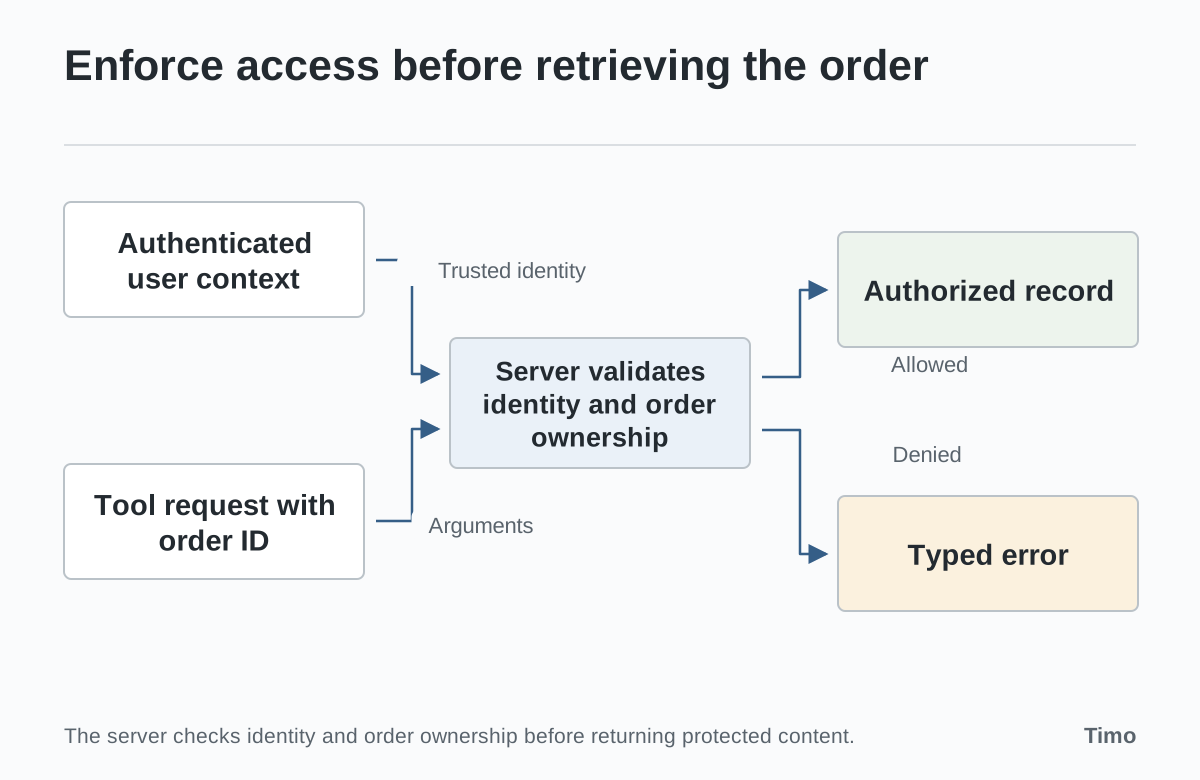
D. Require a typed order_id, validate its ownership against the authenticated customer server-side before retrieval, and return a typed error on mismatch.
Best answer: D. A typed input has a defined shape, such as an order identifier string in the expected format, rather than an unrestricted description from which the tool must guess. That reduces ambiguity, but it does not establish permission. The service must also check that the requested order belongs to the authenticated principal: the user identity established by the trusted sign-in process.
That identity should come from the application session, not from a customer_id invented or repeated by Claude. The server can enforce ownership through an authorized lookup that combines the requested order ID with the signed-in customer's scope. No order contents should be returned to Claude unless the check succeeds.
A typed error is a distinct result the application can recognise, such as ACCESS_DENIED, rather than a vague sentence mixed with normal data. The application can then offer the appropriate recovery without exposing another customer's order. Where policy requires it, the user-facing wording can avoid revealing whether that order exists.
Why the alternatives are weaker: A checks permission after the sensitive record has already reached the agent. B improves the instructions and catches some ambiguous strings, but supplies no authoritative ownership check. C separates the fields while asking the model to decide whether the relationship is valid. A model-supplied customer identifier is not evidence that the signed-in user may access the order.
Practice question 2: structured output at an API boundary
A service asks Claude to extract invoice fields for another application. The receiving application expects JavaScript Object Notation (JSON), a structured text format made of named fields and values, and requires dates in a particular format. Most responses are usable, but some include an extra explanatory sentence or an unsupported date representation.
An application programming interface (API) defines how software components communicate. Its boundary is where information passes from one component to another under that contract. Which implementation provides the strongest protection at this boundary?
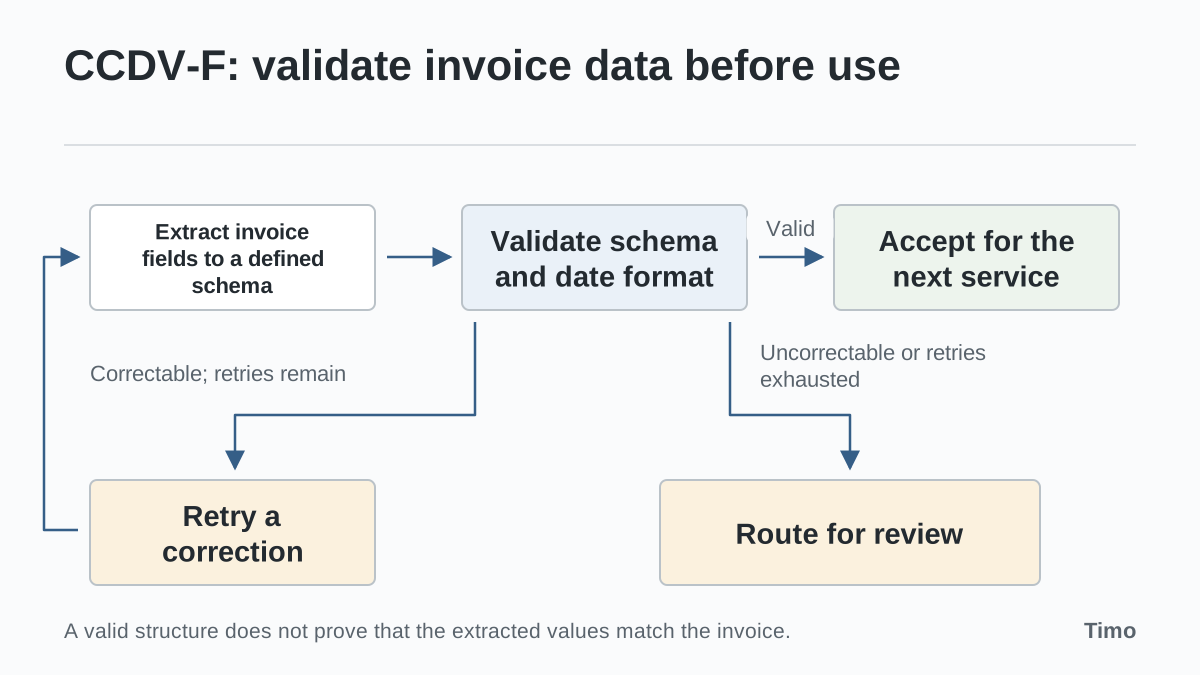
A. Request output against a defined schema, validate both structure and supported date formats, retry only correctable failures, and route persistent failures for review.
B. Extract the first JSON object from the response, validate that required keys exist, and let downstream services normalise field values.
C. Ask for a JSON example in the prompt, parse the response, and record parsing failures for a later engineering review.
D. Store the raw response and a parsed version so downstream services can choose which representation to trust.
Best answer: A. A schema defines the expected fields, types, and restrictions. The validator checks the returned data against those rules before it enters the consuming workflow. Parsing only establishes that text can be read as JSON; validation establishes whether that JSON meets the contract.
For instance, a response can be valid JSON while containing a date the receiving service cannot interpret. A required key can also be present with the wrong type or an unusable value. The application should distinguish those conditions rather than treating successful parsing as acceptance.
Some failures are correctable: the service may ask for a response in the required format and validate it again. Keep that retry bounded so persistent failures do not create an endless loop. If the source invoice itself has an ambiguous date, a formatting retry should not guess its meaning. Route that uncertainty for review. Structural validity also does not prove the extracted amount or date matches the invoice; source accuracy remains a separate check where the workflow requires it.
Why the alternatives are weaker: B assumes downstream normalisation can repair any field once the JSON is readable. C uses a helpful example and retains diagnostic information, but leaves the contract's value checks and immediate recovery incomplete. Parsing failures need handling now, not only later investigation. D preserves useful debugging evidence, but asks each consumer to invent its own trust rule. The producing service should provide one validated result or a clear failure state.
Practice question 3: isolating an intermittent failure
An agent occasionally tells customers that inventory is unavailable. The inventory tool can return a positive stock count, a confirmed count of zero, or a timeout when the service does not respond in time. The integration currently maps zero stock and timeout to the same “unavailable” state before sending the result to Claude.
Recorded request traces show that timeouts account for some of the misleading replies. Which test and code change should come first?
A. Add prompt examples for zero stock and timeout, then compare whether Claude uses different customer wording for each case.
B. Increase the timeout and add one retry before returning the same unavailable state to the agent.
C. Add an integration test for success, zero stock, timeout, and malformed responses; map each outcome to a distinct application state before Claude writes the message.
D. Add monitoring for tool timeouts and ask support staff to correct affected conversations after they are reported.
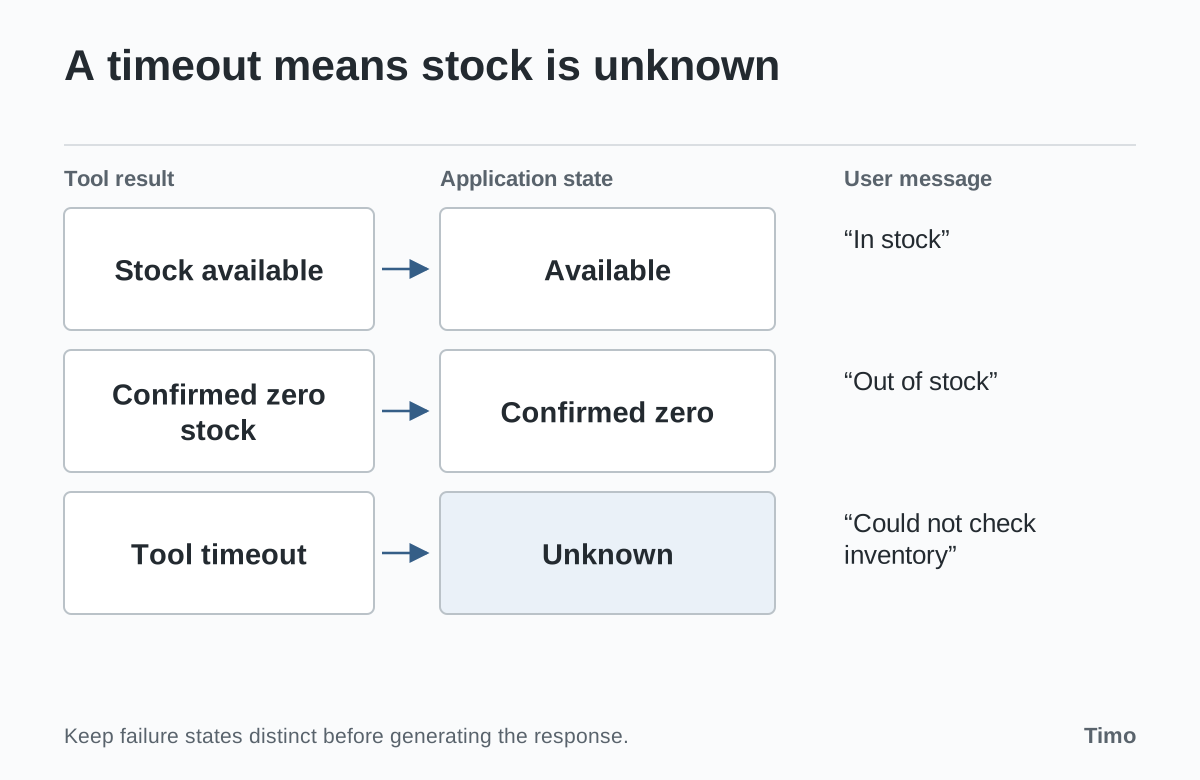
Best answer: C. A zero-stock response is evidence about inventory. A timeout is evidence that the application did not obtain an answer. Once integration code collapses those outcomes into one value, Claude cannot reliably reconstruct the distinction.
An integration test exercises the connection between components. Here, controlled tool responses should verify that the application preserves a positive count, a confirmed zero, a timeout, and an invalid response as different outcomes. A malformed response, such as a stock count in an unexpected format, must not silently become zero either.
The user message can then follow the state: “There are five available” for a supported count, “This item is currently out of stock” for a confirmed zero, and “I couldn't check stock just now” for a failed lookup. Those examples illustrate the required distinction; exact wording can vary without changing the underlying meaning.
Why the alternatives are weaker: A supplies examples for a difference the application has already erased. B may reduce temporary failures, but any remaining timeout still becomes a false stock conclusion. D helps locate incidents after users encounter them; it does not correct the state mapping that causes them.
Review the answer by locating the control
For every question, identify the input or output contract, the possible failure, and the layer responsible for handling it. In the order example, ownership belongs at the server boundary. In the invoice example, acceptance belongs in validation before downstream use. In the inventory example, the integration must preserve the tool outcome before text generation.
Then name a test that would fail under the original design and pass under the revised design. For ownership, use a signed-in test customer requesting another test customer's order. Verify that the agent receives no protected contents. For inventory, hold the prompt constant while supplying a timeout fixture. A fixture is a controlled sample response used to make the case repeatable.
Build one small preparation exercise
Choose a read-only tool and create controlled responses for success, an authoritative empty result, permission failure, timeout, and malformed data. Record the tool response, the application's interpretation, and the final user message separately. This lets you locate the first incorrect step instead of blaming every failure on the model.
Change one component at a time. If application state is already wrong, fix its mapping before experimenting with prompts. If state is correct but the final wording changes its meaning, test the model instructions against the same fixtures. The Claude certification readiness checklist can help you choose further preparation that develops this kind of implementation reasoning.
CCDV-F mock exam FAQs
Is this a complete CCDV-F mock exam?
No. It is an independent three-question preview. It demonstrates useful review techniques without claiming full blueprint coverage.
Do these questions come from the live exam?
No. Timo wrote these scenarios independently and does not publish recalled, copied, or protected exam items.
What should I practise beyond multiple-choice questions?
Build a small integration with a narrow tool contract, server-enforced access, validated output, and controlled failures. Show both what the application knows and what the user sees.
Should I memorise SDK methods?
A software development kit (SDK) provides tools and methods for building an integration. Use the current provider guide to set your study scope. Alongside relevant product details, practise explaining where permissions are enforced, why an output is accepted, and how an operation recovers from failure.
Can three correct answers predict whether I will pass?
No. A small preview cannot reproduce the breadth or conditions of an official assessment. Use errors and weak explanations to direct further practice.
How can Timo help me prepare for CCDV-F?
Timo helps you prepare for CCDV-F through Claude learning, developer practice questions and practical assessments. The exercises here help you identify gaps in tool authorization, structured output and failure handling. Use those findings to build a small integration that shows both the application’s state and the user’s message. Timo is run by Amotion AI, a registered member of the Claude Partner Network.
Apply for CCDV-F preparation and name the skills you want to improve. Membership is US$50 for two months; Timo reviews your profile and shares the enrollment details before payment. Current learning resources and onboarding instructions arrive by email. Anthropic sets official exam eligibility and fees and awards the credential.