
A Claude service can meet its pilot accuracy target and still be difficult to operate responsibly. The test may omit the cases with the greatest consequences. Its sources may become stale without triggering an alert. During an incident, three teams may each own a component while no one can decide whether to stop the service.
Useful CCAR-P mock exam practice brings those concerns into the architecture decision. For Claude Certified Architect – Professional (CCAR-P), the question is how a solution can be designed, evaluated, approved, and operated across its lifecycle. These three original Timo scenarios ask you to connect technical choices with the people and evidence needed to sustain them.
This is an independent practice preview, not official Anthropic exam content, recalled material, a full timed assessment, or a prediction of your result. Choose the best answer under the conditions stated, then explain what the strongest alternative leaves unresolved.
Timo is run by Amotion AI, a registered member of the Claude Partner Network, and gives individuals a route to Claude learning and certification preparation as they develop their AI consulting skills. For Professional-level architects, its original practice scenarios connect technical design with release evidence, operational ownership and business consequences. Use the questions here to examine how you would make and defend those decisions.
What you are practising at Professional level
The provider's Architect Professional guide describes responsibilities across solution architecture, models and context, integration, evaluation, governance, stakeholder communication, and ongoing operation. The Timo Architect Professional guide provides a role overview.
Use the provider’s certification listing and current guide to confirm eligibility and assessment details before planning your exam.
Enterprise architecture connects a service's intended outcome to its supporting systems and operating responsibilities. The architect needs to know what the system may do, what evidence supports release, who approves consequential decisions, and how the organisation responds when the evidence changes. The following questions examine release control, information access, and service ownership.
Practice question 1: governing a claims assistant
A global insurer plans to let a Claude assistant recommend claim dispositions: proposed outcomes such as approval, denial, or referral for further review. Policies differ by jurisdiction, and an incorrect denial could have serious consequences. The available evaluation set contains only routine historical cases.
The sponsor wants a company-wide launch after one accuracy test. What should the architect recommend?
A. Run the assistant globally in shadow mode, compare its recommendations with adjuster decisions, and agree acceptance and rollback criteria after collecting a month of results.
B. Limit the launch to routine cases in one jurisdiction, keep the current historical evaluation, and require adjusters to approve every recommendation.
C. Limit the first release by jurisdiction and case class, add edge and adverse cases to evaluation, require accountable human approval, monitor by risk category, and set rollback criteria before launch.
D. Expand the evaluation set across jurisdictions before launch, then automate decisions only for cases where the model reports high confidence.
Best answer: C. The evidence used to approve a release should represent the work and consequences of that release. Narrowing the first scope makes it possible to evaluate the relevant policy and case types carefully. Adding edge cases and adverse cases means including unusual situations and situations where a wrong recommendation could cause harm, rather than measuring performance only on routine examples.
Human approval provides a decision point for an accountable adjuster, but the reviewer needs usable evidence and clear instructions for handling uncertainty. Monitoring should distinguish meaningful risk categories, such as incorrect denial recommendations, rather than hiding them inside one average score. Rollback criteria define the conditions under which the service will be paused or returned to a previously approved configuration. Agreeing them before launch gives the operating team a decision rule when problems appear.
Why the alternatives are weaker: A's shadow mode produces recommendations without using them to decide claims, which can be valuable for learning. Its weakness is starting globally while postponing agreement on acceptable results and stop conditions. Shadow operation still needs approved scope and controls. B is a stronger starting point than an unrestricted launch, but retains the routine-only evaluation despite the known importance of exceptional cases. Human review does not make that evidence gap disappear. D broadens evaluation but treats the model's own confidence as permission to automate. A confidence statement does not establish that a recommendation is correct or that automated decision-making has been approved.
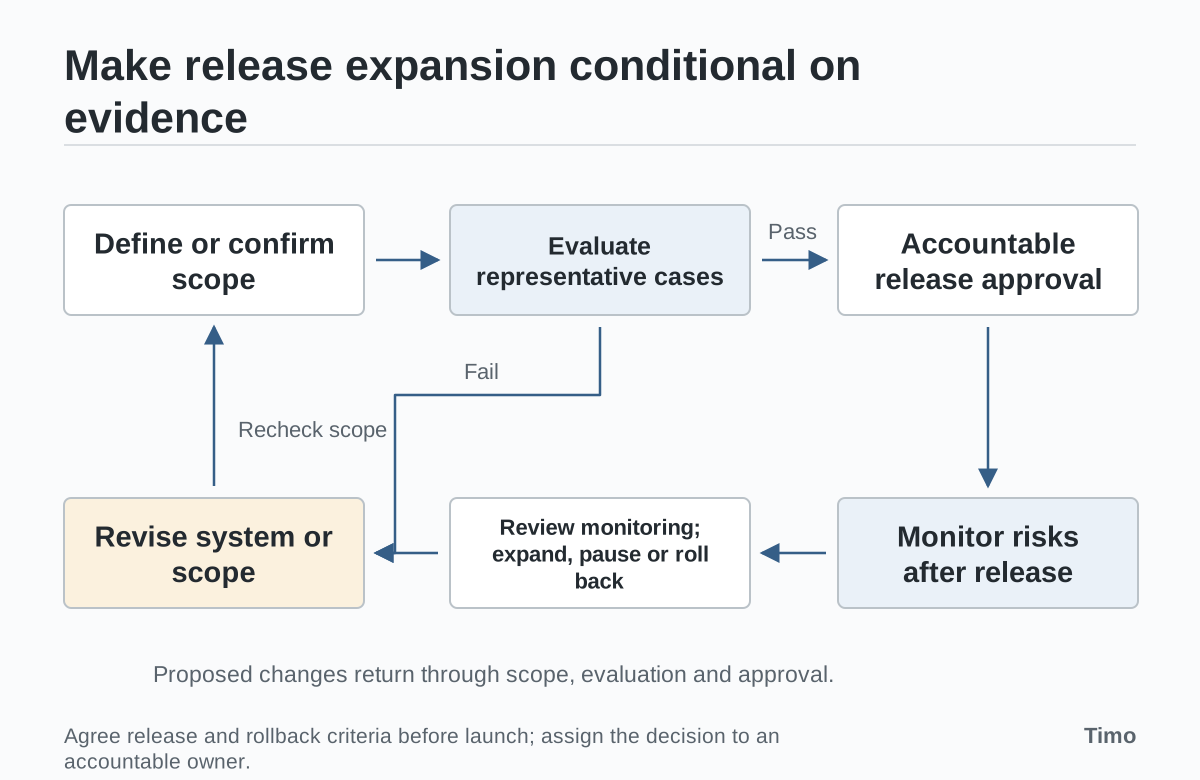
The general lesson is that launch approval must describe a specific use. “The model tested well” is incomplete until the team can say which cases were tested, which failures matter, and which decisions remain with people.
Practice question 2: choosing an enterprise integration pattern
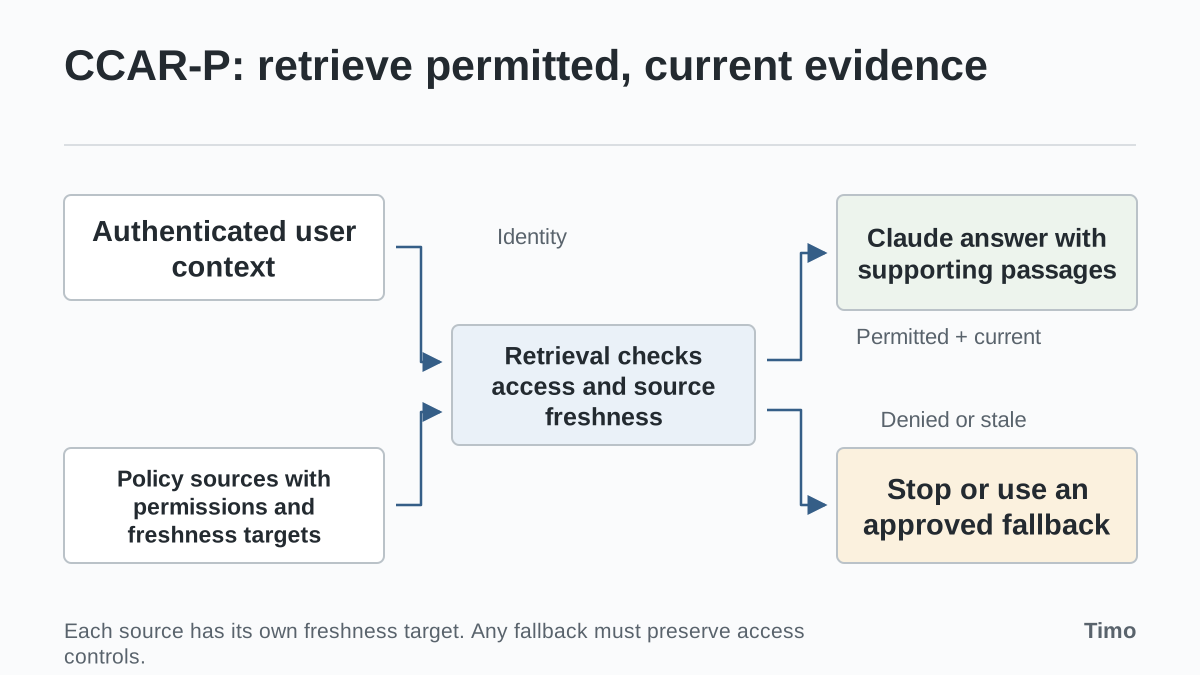
Several business units need an assistant to retrieve internal policies. Sources have different access rules and update cycles. Security explicitly requires unauthorised passages to be excluded by the retrieval layer, before they enter the application's retrieved result set. Each source must also meet its own freshness target: the maximum permitted delay between a source change and the assistant's usable copy.
A central team proposes copying all documents into one shared index with a service account that every assistant uses. An index is a searchable representation of the documents; a service account is a software identity used to access a system. Which design best meets the stated requirements?
A. Preserve source ownership and access metadata, enforce user-scoped authorization during retrieval, define freshness expectations per source, and log passages supporting each answer.
B. Build separate indexes by business unit, refresh them on one company-wide schedule, and use a shared service account limited to read access.
C. Keep one central index with document access labels, retrieve broadly under a service identity, and filter passages against the user's permissions before prompting Claude.
D. Query each source under its own service identity and rely on application routing to ensure users reach only their business unit's connector.
Best answer: A. The retrieval layer—the part of the system that finds and returns relevant source material—must apply the requesting user's permissions while selecting passages. Access metadata records which users or groups may see a source. Preserving that information allows the search to exclude unauthorised content before it becomes an application result.
Freshness is a separate responsibility. One source may change infrequently while another publishes urgent revisions. Each owner needs an agreed refresh expectation and a way to detect when the assistant's copy falls outside it. Depending on the approved policy, stale material may require a warning, a fallback to the authoritative source, or suspension of answers using that source.
Logging the passages and source versions supporting an answer helps reviewers investigate what information was used. Those logs also need appropriate access and retention controls; recording evidence should not create a new unrestricted copy of sensitive material.
Why the alternatives are weaker: B separates business-unit collections, but a shared read identity does not establish each user's entitlement, and one refresh schedule may miss a source's required update speed. C contains a useful filtering idea, but applies it after broad retrieval. That directly violates the scenario's requirement that unauthorised passages be excluded at the retrieval layer. D preserves separate sources but assumes business-unit routing is sufficient permission control. People within one unit may have different access, and users may have legitimate permissions across units.
The best answer does not require a particular number of indexes. A central or distributed implementation could work if it enforces the specified permissions and freshness rules. The architecture decision is about those behaviours, not the diagram's shape.
Practice question 3: resolving multi-team operating ownership
A Claude service meets its launch quality target, but incidents take too long to resolve. The application team owns prompts, the platform team owns the gateway through which requests pass, and compliance reviews logs. Each team can see its component, but no one owns the complete user outcome or has agreed authority to coordinate a service-level response.
Which action best improves lifecycle reliability?
A. Keep component ownership and add a shared dashboard that alerts all three teams when user-visible quality falls below the launch target.
B. Rotate incident command between the application and platform teams, while compliance retains approval for any change involving logs.
C. Give the application team end-to-end incident ownership because it controls the user experience, with other teams consulted when their component fails.
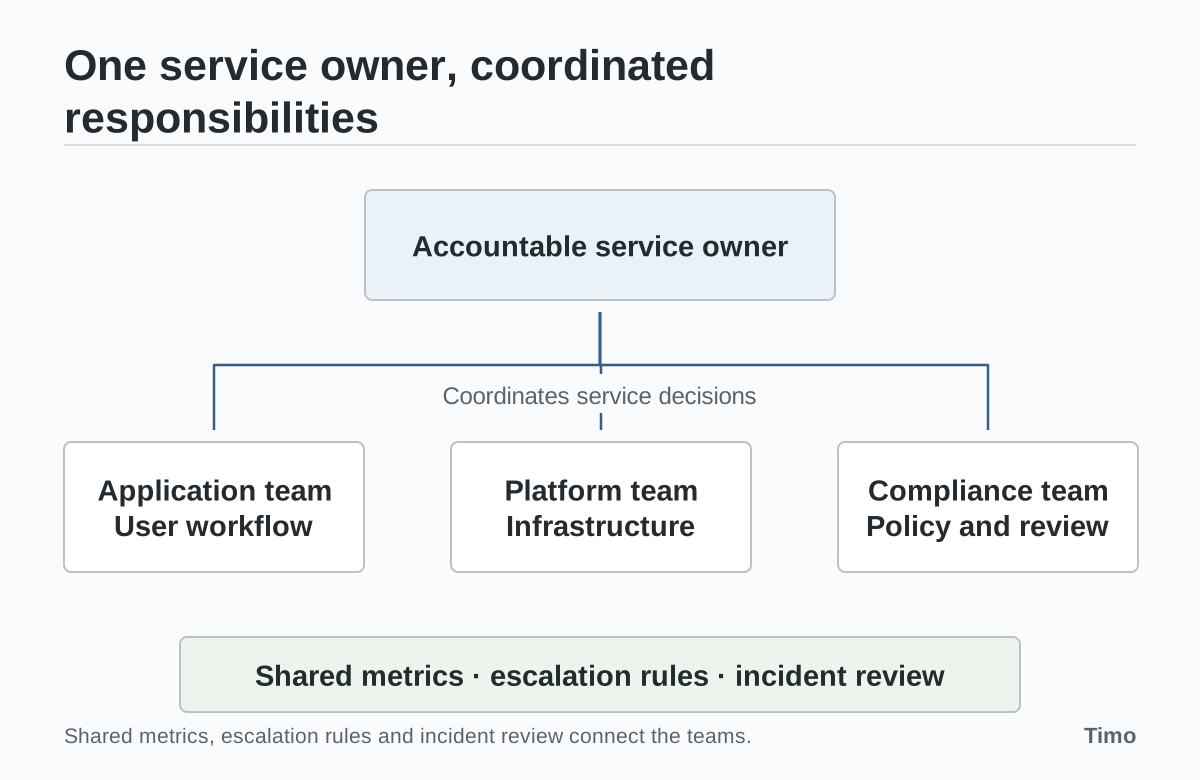
D. Define one accountable service owner, shared service-level indicators, severity and escalation rules, change boundaries, and a cross-team post-incident review process.
Best answer: D. One accountable service owner gives the organisation a clear point of responsibility for whether the complete service is working acceptably. That owner needs agreed authority and a coordination process; naming someone without those decision rights would leave the original problem intact.
Service-level indicators are measurements of the service users experience. Alongside response time and availability, an AI service may need measures of unsupported answers, failed evidence retrieval, or cases requiring human review. Severity rules describe how serious an incident is, escalation rules identify who must become involved, and change boundaries define who may alter or pause which part of the service.
Component ownership remains useful. The application, platform, and compliance teams retain their specialist responsibilities, while the service owner coordinates the outcome across them. A joint post-incident review can then examine how the complete service failed and assign corrective actions that cross team boundaries.
Why the alternatives are weaker: A improves visibility but cannot decide who acts when an alert fires. B can distribute incident-command duties, but does not establish enduring service accountability or resolve fragmented change authority. C names a team and may be workable if authority and operating agreements are added. As written, however, it assumes control of the user interface gives that team the ability to direct platform and compliance decisions. D explicitly establishes the missing operating structure.
Turn the answer into a reviewable decision
For each scenario, write a one-page decision record that connects the intended business outcome to the proposed design. Include the consequential failure, the evidence required for approval, the people with decision authority, and the condition that would trigger a pause or revision.
In the policy assistant example, that means naming who owns each source, how retrieval enforces access, how freshness is measured, and who responds when a source becomes stale. “We will monitor the system” is not enough: identify the signal and the action it enables.
Then run a tabletop incident, a discussion in which the team walks through a plausible failure without affecting a live service. Suppose a source stops refreshing while the application remains available. Trace who detects the problem, which answers are affected, who can suspend that part of the service, and what must be checked before it resumes. The exercise reveals whether the architecture and operating agreements work together.
Use the Claude certification readiness checklist to compare further resources. Prefer explanations that connect a technical choice to its evidence, consequences, and operating owner.
CCAR-P mock exam FAQs
Is this an official CCAR-P mock exam?
No. This is an independent three-question Timo preview. Anthropic has not supplied, reviewed, or endorsed it.
Does this use recalled or copied exam content?
No. These enterprise scenarios were written independently and are not presented as live assessment questions.
What makes the exercise professional-level?
The decision must remain credible through release and operation. You need to connect component behaviour with evaluation, risk, accountable approval, incident response, and future changes.
Must I complete every other track first?
This article does not establish a mandatory sequence. Choose preparation according to your responsibilities and the provider's current eligibility rules. Understanding component behaviour will help you reason about enterprise decisions, but that does not mean all four credentials form a required ladder.
Can these three questions predict a pass?
No. They cannot represent full blueprint coverage or official exam conditions. Use them to identify assumptions that need more study and practical testing.
How can Timo help me prepare for CCAR-P?
Timo helps you prepare for CCAR-P through Claude learning, original enterprise scenarios and practical assessments. These exercises let you examine whether a release decision accounts for evidence, permissions, source freshness and operating responsibility. You can then develop a decision record or incident exercise that demonstrates your reasoning. Timo is run by Amotion AI, a registered member of the Claude Partner Network.
Apply for CCAR-P preparation and name the skills you want to improve. Membership is US$50 for two months; Timo reviews your profile and shares the enrollment details before payment. Current learning resources and onboarding instructions arrive by email. Anthropic sets official exam eligibility and fees and awards the credential.