
To draft a monthly management report with Claude or ChatGPT, provide a table of approved actual, budget and prior-year figures, short notes for the known causes, and the headings from last month's report. The tool drafts the report under those headings. An analyst checks every number and explanation, and the controller approves the final report.
The example uses fictional August 2026 figures. Its sample report was written and checked manually; it is not a measured result from either tool.
Finish the calculations before drafting the words
Complete the close and approve the figures before drafting the narrative. Calculate actuals, budget, prior year and variances in the financial system, planning tool or reviewed workbook. Do not use a language model as the official record for posted figures.
The reporting workflow then has five stages:
- Finance locks the source table and notes whose causes have been checked by the relevant owners.
- The analyst supplies that material with the report template and drafting rules.
- Claude or ChatGPT produces a draft.
- The analyst traces every number and explanation to the source.
- The controller approves the final report and records any change.
This sequence gives the tool a specific writing task while the finance team keeps control of the figures and final wording.
Use an approved structure every month
For the fictional company, the management report always contains:
- An executive summary of no more than 90 words.
- A performance table with actual, budget, variance and prior year.
- Commentary for revenue, gross margin, operating expenses and cash.
- Decisions and follow-up questions.
The headings and order are part of the approved template. A drafting tool should populate that structure rather than redesign it each month. Consistent structure helps management compare periods and helps finance notice when a required topic is missing.
Prepare the reporting input
The fictional August 2026 source values are in USD thousands:
| Measure | Actual | Budget | Prior year | Approved notes |
|---|---|---|---|---|
| Revenue | 2,240 | 2,100 | 1,980 | North delivered 140 above budget; other regions were on budget in aggregate. |
| Gross profit | 851 | 819 | 752 | Actual gross margin was 38.0% against 39.0% budget. Freight was 22 above budget. No other cause is approved. |
| Operating expenses | 612 | 640 | 585 | Later hiring created a 34 favourable payroll variance. Marketing was 6 adverse. Other operating expenses were on budget in aggregate. |
| Closing cash | 1,460 | 1,520 | 1,310 | A 95 receipt expected on 29 August arrived on 3 September. No liquidity concern is approved for reporting. |
The “approved notes” column matters. The income statement can show that gross margin fell against budget, but it cannot by itself establish why. Finance should only provide causes that the relevant owner has checked.
Use a prompt that keeps the figures fixed and shows missing explanations
The same instruction can be used with either approved tool; adjust the method of supplying the material to the product and workspace your organization permits. Your organization’s product plan and administrator settings determine how you can attach files or share the material.
You are drafting a monthly management report for controller review.

The attached figures and approved notes are fictional. Use only this source.
Preserve the headings and order in the approved report structure.

Rules:
- Copy no number until you have recalculated its variance.
- Express all amounts in USD thousands unless the executive summary uses USDm.
- Label variances as favourable or adverse from the company's perspective.
- Do not invent causes, forecasts, risks or management actions.
- If the source does not explain a result, say so briefly and add a question
  under “Decisions and follow-up questions.”
- Keep the executive summary below 90 words.

Return:
1. Executive summary.
2. Performance table: actual, budget, variance and prior year.
3. Commentary under Revenue, Gross margin, Operating expenses and Cash.
4. Decisions and follow-up questions.
The instruction limits the draft to the supplied figures, notes and headings. It does not make the output approved.
Review the sample draft
The complete illustrative input and sample output are included with this article. The executive summary reads:
August revenue was USD 2.24m, USD 140k above budget and USD 260k above the prior year. Gross profit was USD 851k, USD 32k above budget, while gross margin was 38.0% against a 39.0% budget; freight was USD 22k above plan. Operating expenses were USD 28k below budget, mainly because hiring started later than planned. Closing cash was USD 60k below budget. A USD 95k late receipt was partly offset by USD 35k of favourable cash movement that the approved source does not explain.
The draft preserves the required order and uses the supplied context. It also needs controller review. Writing “gross margin fell because freight was USD 22k above plan” would overstate the explanation. Freight may explain part of the movement, but the source does not say it explains the full one-percentage-point gap. The detailed commentary therefore states that the remaining movement lacks an approved explanation.
This is the type of issue a human reviewer must resolve. A smooth paragraph can compress a partial cause into a complete explanation.
Run four checks before approval
1. Numerical check
Recalculate each variance from the locked source. In the example:
- Revenue: 2,240 − 2,100 = 140 favourable.
- Gross profit: 851 − 819 = 32 favourable.
- Operating expenses: 612 − 640 = 28 favourable because lower expense is favourable.
- Closing cash: 1,460 − 1,520 = 60 adverse.
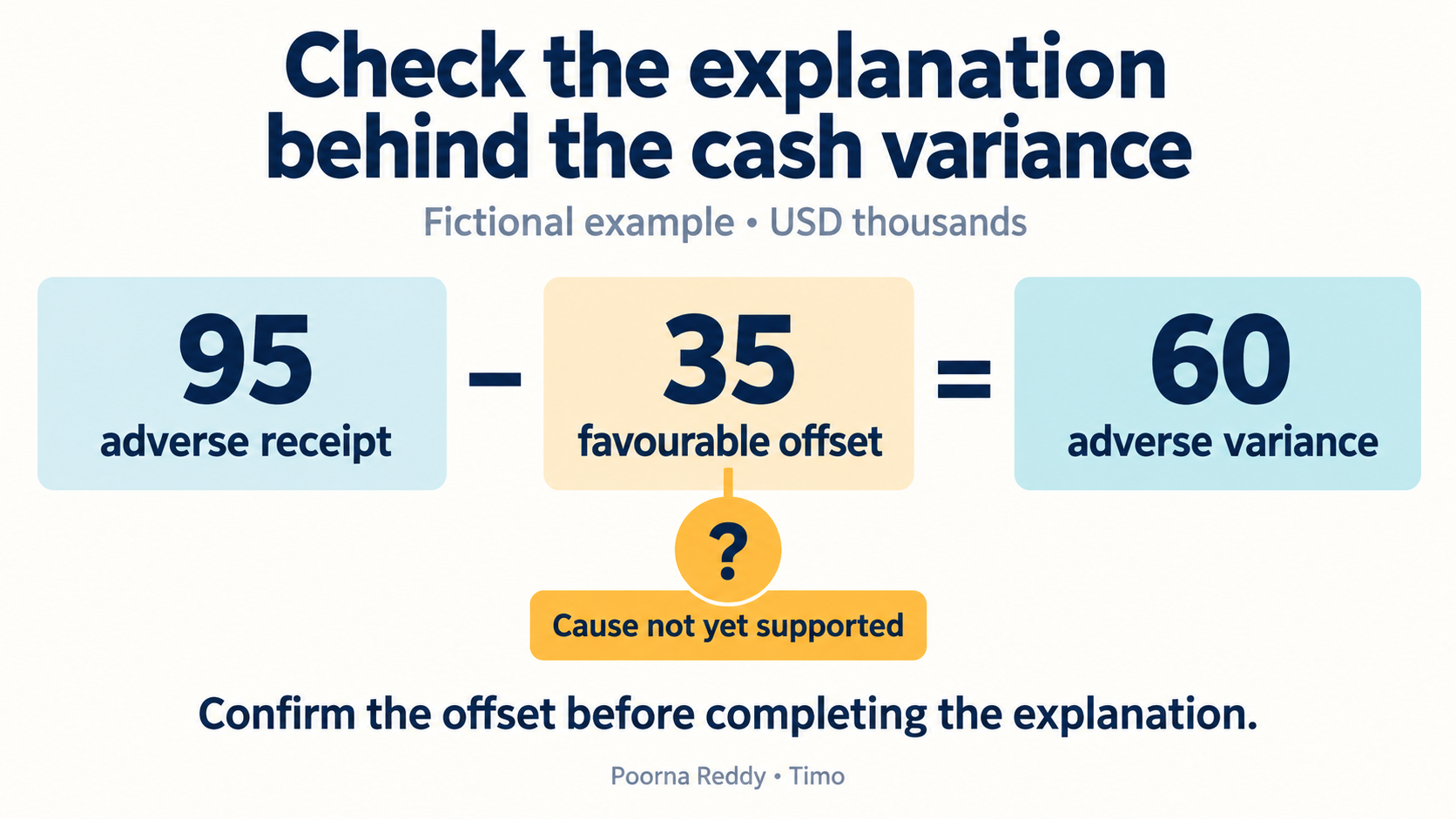
The late receipt explains USD 95k adverse on its own. Because the reported cash variance is only USD 60k adverse, other cash movements created a USD 35k favourable offset. The approved source does not identify those movements, so the report must keep the offset unresolved and request supporting detail.
Trace each figure in the draft back to the source table. Check units, signs, rounding and whether a value is actual, budget or prior year.
2. Explanation check
Underline every causal phrase, such as “because,” “driven by” or “due to.” Match it to an approved note. Move unanswered causes into the follow-up section instead of allowing the draft to guess.
3. Structure and audience check
Confirm that the report preserves the approved headings, order and length. Check whether the executive summary carries the issues that management needs to see, while the detail remains available below.
4. Decision check
Management reports should distinguish an observation from a required decision. In this example, finance can report the delayed cash receipt. Management still has to decide whether the September report needs a separate cash-timing disclosure.
Use a claim register to decide what can be published
A claim register links each sentence to its calculation, explanation and approval decision.
| Draft claim | Calculation | Approved explanation | Gap | Decision |
|---|---|---|---|---|
| Revenue was 140 above budget | 2,240 - 2,100 | North delivered 140 above budget | None in supplied notes | Publish after figure check |
| Gross margin was below budget because of freight | 38.0% versus 39.0% | Freight was 22 adverse | Source does not say freight explains the full gap | Qualify and ask for the remaining bridge |
| Cash was 60 below budget because a 95 receipt was late | 1,460 - 1,520 = -60 | Receipt arrived on 3 September | A 35 favourable offset is unexplained | Publish both known amount and unresolved offset |
| Delayed hiring reduced operating expense | 612 - 640 = 28 favourable | Payroll 34 favourable; marketing 6 adverse | Reconciles to 28 | Publish; ask about delivery effect separately |
The cash sentence is the useful stress test. A 95 adverse explanation cannot, by itself, explain a 60 adverse total. The arithmetic requires another 35 favourable movement. Until finance identifies it, the report should preserve the gap rather than compress the late receipt into a complete explanation.
Set the company's materiality and escalation rules outside the model. The fictional example does not supply a materiality threshold, so the article cannot decide which gap the controller may waive.
Anticipate board questions without inventing answers
After the report is checked, ask the tool to produce questions that a board or management team might ask. Keep the request separate from the approved narrative:
Using only the checked report, list up to five questions a board member may ask.
For each question, identify the source value that prompted it. Do not answer a
question unless the report contains the answer. Label missing evidence.
For the example, reasonable questions include:
- What explains the gross-margin gap that the freight variance does not explain?
- Will delayed hiring affect delivery or create a later cost catch-up?
- What caused the receipt delay, and is there a repeat-risk that management should monitor?
- What produced the unresolved USD 35k favourable cash offset?
These are preparation questions. They are not findings and should not be inserted into the report as facts.
Check which financial data you may upload
The organization should approve the product, account, data classes and retention settings before any management-report material is supplied.
OpenAI states that data from ChatGPT Business, Enterprise, Edu and its API is not used for model training by default. OpenAI also explains that administrators of managed ChatGPT accounts may control, retain, export or audit workspace content under the organization's settings and agreement.
Anthropic states that it does not use Claude for Work customer data to train generative models. It also documents retention differences among its commercial products. Retention and feature configuration can vary, so the organization should check the applicable plan, agreement and current administrator controls.
These vendor commitments do not decide whether a particular management report may be uploaded. The controller, security owner, privacy owner and workspace administrator should apply the organization's classification and acceptable-use rules.
Keep the same files and checks each month
Keep five items together: the approved template, the definition of each source field, the table of approved explanations, the drafting instruction and the review checklist. Save a new version when a heading, metric, currency rule or approval owner changes.
Record material corrections to each draft. A correction log shows whether the recurring problem is the input data, an unclear instruction or an explanation without support. It helps the controller decide whether to keep using the process.
The fictional input and reviewed sample output are included with this content pack. Follow Poorna Reddy for more practical examples of AI-assisted business workflows with visible controls.
Sources
- OpenAI, Business data privacy, security and compliance
- OpenAI Help Center, Data access for a managed ChatGPT account
- Anthropic Privacy Center, How long do you store my organization's data?
- Anthropic Help Center, Does Anthropic act as a data processor or controller?